In reading information in the Kapiti News and seeing KCDC correspondence, KCDC seems to be pushing the false line that DoC is supportive of the Guru Gateway’s Business Case. False because this is what DOC does say:
20-E-0417 DOC-6386743
7 August 2020
Mr Christopher Ruthe
Dear Mr Ruthe
Thank you for your Official Information Act request to the Minister of Conservation relating to the Kāpiti Gateway Proposal dated 10 July 2020.
The Minister has transferred the following request included in that letter to the Department for response under section 14(b) of the Official Information Act:
Please supply the economic studies and data you have that justified your opposing the facts as seen by the business community you project as being the beneficiaries of the project.
I advise that there were no such economic studies or data held by the Department. The Kāpiti Gateway proposal is being developed by the Kāpiti Coast District Council and the Department has no role to suggest the business community is a beneficiary or otherwise.
At the August meeting of the Kapiti Historic Society about 30 members listened to an informative presentation by CEO Wendy Huston of the Kapiti Retirement Trust and the images here were among those shown in the talk. Essentially it is a not-for-profit organisation which exists to provide facilities and care for a significant number of retired Kapiti people. These have a variety of needs from simple living in a retirement community of older folk to hospital level residential care for those with complex health needs.
The trust dates back to 1957 and those who drive along the western half of Kapiti Road will notice the Sevenoaks complex, roughly opposite the airport. The beginning came with the Marire Home and progressed from there. Marire Home is off McGrath Ave, at the west end of the airport, directly adjacent to where the Trust now has its Muriwai Court site.
A flowery ‘Mission Statement’ became almost obligatory for any enterprise in the 1990s — but that of Kapiti Retirement Trust was deliberately kept short and simple.
The majority of villas in the Sevenoaks Midlands Gardens retirement Village were built over the period 1980s–2000. The Trust’s aged care hospital The Lodge, along with the Sevenoaks apartments were built in the 1980s.
The lakes at Sevenoaks and Midlands Gardens were some of Kapiti’s first lakes within residential subdivisions, developed as ways to sustainably drain low-lying land which were subject to a high water table.
The three sites – Muriwai Court, Sevenoaks and Midlands Gardens — occupy 16 hectares (40 acres).
Wendy’s involvement began when she applied for her role in 2009. She said her first test of whether it would be an environment she would like was the “sniff test” — close your eyes and see if you like the smell. Readers who have had reason to visit friends or relatives in a rest home will know that they often have a distinct odour of disinfectant. Not at Kapiti Retirement’s complex, so that test was passed!
At that time, the official name of the entity was the Kapiti District Trust, which could have meant anything — one of Wendy’s first measures was to have the name changed to the more suitable Kapiti Retirement Trust. Gross assets now stand at $109 million, of which $81 million is licensees’ interests in the properties they occupy.
Although the trust’s village operates on the same “License to Occupy” model that the other retirement villages in Kapiti use, unlike them, the Trust does not have shareholders who require a dividend. To a large extent, commercial retirement villages are primarily property development companies and make money on service fees plus hefty deferred management fees on resale, but not Kapiti Retirement Trust. What surpluses it makes on the village cover losses on the care side of its operation. And when it comes to capital gains on the units’ value when the occupier leaves it, unlike the other villages which keep it, Kapiti Retirement trust’s policy is to give half the capital gain to the licence holders (or their heirs), which is very generous by industry standards.
As can be seen from the financial results, the Care division typically makes a significant annual loss. This is added to by the higher than normal staff ratio. While the industry average is 1 staff member to 10 residents, with Kapiti Retirement Trust it is 1 to 6.
In addition to the staff. there is a team of over 90 volunteers – quite a few from the village but also lots from the community (including our co-Editor Roger Childs) and they range in age from school age through to several in their 90s. They work with residents in care and also in the respite day unit The Nikau Club.
The volunteer work was badly hit by Lockdown and the death of resident Paddy McCann made the news back in April. Says Wendy: “Paddy didn’t die of Covid but his family consider (and I share their view) he was a victim of Covid. Paddy was a totally social individual and lived every day to the full. He became totally immersed in all that happened around the Lodge filling his days by attending and being involved in every possible activity. He was also a devout Catholic and his faith meant so much to him. When we had to stop all activities and all volunteers and families coming in at Level 4 Lockdown (which for aged care was even stricter than out in the community) Paddy’s reason for getting up in the morning disappeared. It was just so sad. The one plus for us was that we ensured he had family which meant everything to him, right through with him until his death even though this wasn’t the norm during this time.”
As can be seen from the visuals, the complex is fairly extensive and provides different forms of accommodation depending on the occupants’ needs or wants. The minimum age is 70 for a resident, which is below that of some commercial operations.
Trustees are invited by the existing board to fill vacant positions when they become available, but then have to be elected at the next AGM of the Trust. Over the past decade there has always been a resident from the Trust’s retirement village on the Board, but they are there first and foremost because of the skills they bring to the Board. The Trust’s constitution provides for up to three of the seven Trustees being residents in the village.
Wendy sees the operation as taking the best of capitalism and socialism. If the business side of the Trust (its retirement village) does ‘good business’ then it has the financial means to support its charitable purpose — care services for older people.
Specially for those watching the BBC’s The Salisbury Poisonings and why it and the latest saga regarding Alexy Navalny are highly dubious.
by Craig Murray
Once Navalny was in Berlin it was only a matter of time before it was declared that he was poisoned with Novichok. The Russophobes are delighted. This of course eliminates all vestiges of doubt about what happened to the Skripals, and proves that Russia must be isolated and sanctioned to death and we must spend untold billions on weapons and security services. We must also increase domestic surveillance, crack down on dissenting online opinion. It also proves that Donald Trump is a Russian puppet and Brexit is a Russian plot.
I am going to prove beyond all doubt that I am a Russian troll by asking the question Cui Bono?, brilliantly identified by the Integrity Initiative’s Ben Nimmo as a sure sign of Russian influence.
I should state that I have no difficulty at all with the notion that a powerful oligarch or an organ of the Russian state may have tried to assassinate Navalny. He is a minor irritant, rather more famous here than in Russia, but not being a major threat does not protect you against political assassination in Russia.
What I do have difficulty with is the notion that if Putin, or other very powerful Russian actors, wanted Navalny dead, and had attacked him while he was in Siberia, he would not be alive in Germany today. If Putin wanted him dead, he would be dead.
Let us first take the weapon of attack. One thing we know about a “Novichok” for sure is that it appears not to be very good at assassination. Poor Dawn Sturgess is the only person ever to have allegedly died from “Novichok”, accidentally according to the official narrative. “Novichok” did not kill the Skripals, the actual target. If Putin wanted Navalny dead, he would try something that works. Like a bullet to the head, or an actually deadly poison.
“Novichok” is not a specific chemical. It is a class of chemical weapon designed to be improvised in the field from common domestic or industrial precursors. It makes some sense to use on foreign soil as you are not carrying around the actual nerve agent, and may be able to buy the ingredients locally. But it makes no sense at all in your own country, where the FSB or GRU can swan around with any deadly weapon they wish, to be making homemade nerve agents in the sink. Why would you do that?
Further we are expected to believe that, the Russian state having poisoned Navalny, the Russian state then allowed the airplane he was traveling in, on a domestic flight, to divert to another airport, and make an emergency landing, so he could be rushed to hospital. If the Russian secret services had poisoned Navalny at the airport before takeoff as alleged, why would they not insist the plane stick to its original flight plan and let him die on the plane? They would have foreseen what would happen to the plane he was on.
Next, we are supposed to believe that the Russian state, having poisoned Navalny, was not able to contrive his death in the intensive care unit of a Russian state hospital. We are supposed to believe that the evil Russian state was able to falsify all his toxicology tests and prevent doctors telling the truth about his poisoning, but the evil Russian state lacked the power to switch off the ventilator for a few minutes or slip something into his drip. In a Russian state hospital.
Next we are supposed to believe that Putin, having poisoned Navalny with novichok, allowed him to be flown to Germany to be saved, making it certain the novichok would be discovered. And that Putin did this because he was worried Merkel was angry, not realising she might be still more angry when she discovered Putin had poisoned him with novichok
There are a whole stream of utterly unbelievable points there, every single one of which you have to believe to go along with the western narrative. Personally I do not buy a single one of them, but then I am a notorious Russophile traitor.
All about extravagance, rorts, and rip-offs at the expense of Taxpayers
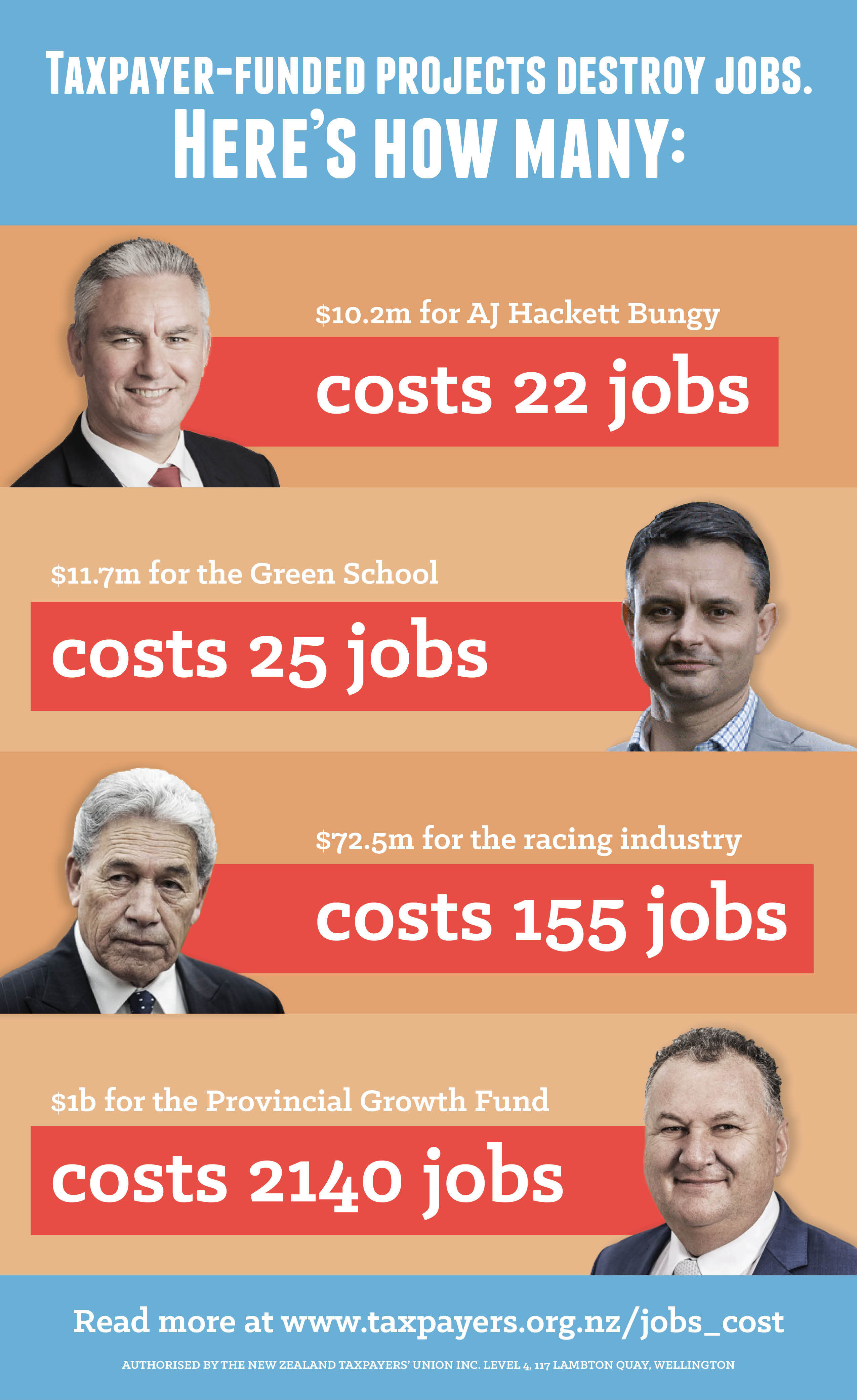
New paper reveals how ‘job creation’ projects destroy jobs
Too often, our politicians fall into the trap of thinking they can create jobs by piling on more and more government taxpayer spending. But if that were true, high-spending countries like Greece and Spain wouldn’t be facing a decades-long employment crisis.
The Taxpayers’ Union‘s latest briefing paper reveals how Government spending – including projects intended to create jobs – destroys productivity and employment.
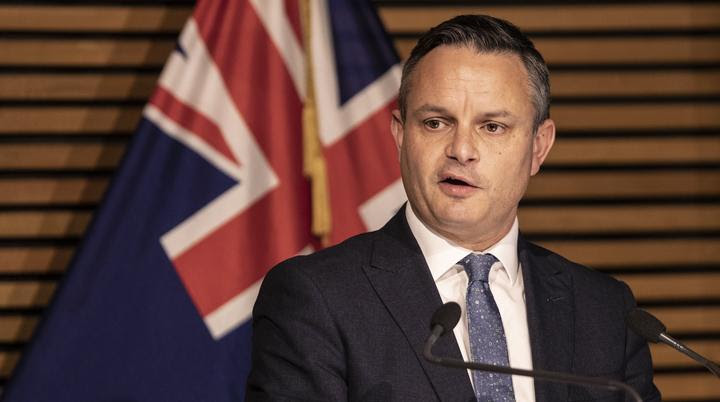
We draw on work from Treasury and New Zealand economists estimating the ‘deadweight loss’ of our tax system – this is the way taxation motivates people to work less, and spend and invest less, leading to economic distortions. Applying it to some recently announced pet projects is sobering: Because government spending projects are funded via taxation, we can use what economists call the “deadweight loss” to see how many jobs are killed by handouts such as James Shaw’s $11.7 million grant to a “Green School”.
While it’s true that economic stimulus is needed in the era of COVID-19, this needn’t come in the form of giant cheques. Leaving this money in the economy via lower tax rates will allow money to circulate in a way that creates jobs passively, without costly perverse incentives.
Taxpayers rorted by Labour MP’s electorate office dealThe cozy deal between list MP Ginny Anderson (pictured above with the Debt Monster), the Labour Party, and the NZ Professional Firefighters Union is a rort on taxpayers.
As Stuff explains, Labour gets cheap rent on office space off a local union, sublets the rooms to Andersen, and then bills parliament (i.e. taxpayers) at a markup, pocketing the difference.Taxpayer funding for offices is meant to cover the costs of being an MP and servicing constituents. Here, Ginny Anderson has abused that trust to line the pockets of her political party.This sort of union backhander is what we’d expect to see in the corrupt unions of Australia. Here in New Zealand, we expect such favours to be disclosed as donations, so why weren’t they?With the discounted rent not being disclosed as a political donation, we’ve referred the matter to the Electoral Commission.We’re also writing to every other MP to ensure they’re not funneling their office funding to political mates or their business interests.
“Green School” handout shows dangerous trend of horse-trading over funds It’s been revealed that James Shaw put billions of dollars in infrastructure funding on the line in order to negotiate his $11.7 million handout for a private “Green School”.This is a perfect example of a worrying trend in the way the Government makes funding decisions. Here’s what Jordan had to say:
The spectacle of politicians horse-trading individual funding decisions is something we expect to see in smoke-filled rooms of yesteryear, not a modern day New Zealand with a reputation of being corruption-free.The Provincial Growth Fund, and now the COVID ‘shovel ready’ fund, are normalising a process of decision making that rewards companies which are politically connected. It is a dangerous path.Steven Joyce reintroduced the sort of corporate welfare largess not seen in New Zealand since the Muldoon Government. But instead of fixing the problem, the current Government has doubled down and we have now returned to politicians making funding decisions for individual projects and pet causes.Enough is enough. Now we are seeing the warts and all flaws in the process, New Zealand should return to a transparent process of the politician’s job being limited to setting criteria and objectives, and leaving it to officials to make the individual grant decisions.
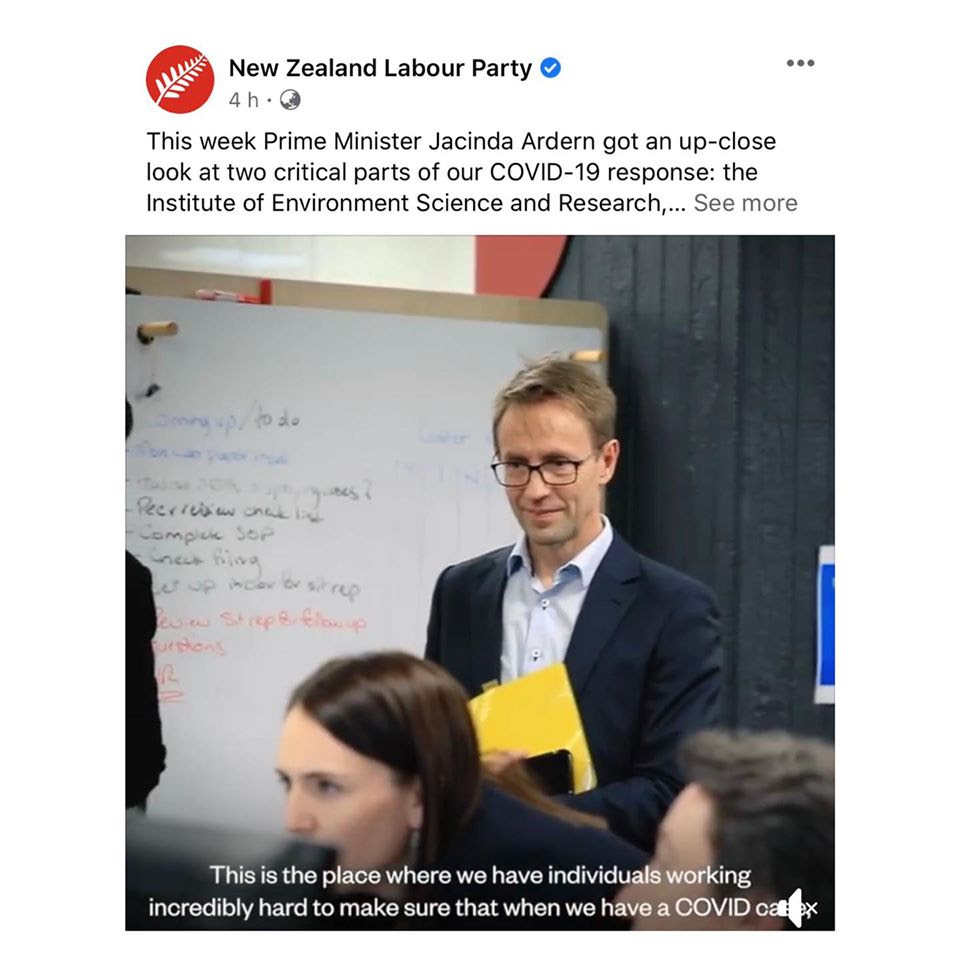
State Services Commissioner responds to our complaint regarding the Ardern-Bloomfield ad Remember the Labour Party’s ad featuring Dr Ashley Bloomfield and other public servants? We complained to the State Services Commissioner that it was an improper use of taxpayer-funded staff.
Now, the Commissioner has responded: It would not be appropriate for a public servant to agree to feature in party political electoral material in their official capacity where this implies endorsement by the public servant of the political party. To do so would compromise their political neutrality and by implication that of the Public Service as a whole. … Placing footage of Ministers and public servants doing their official work on a political party branded platform could create confusion about the motivations and political neutrality of the public servants concerned. … In this instance, and having regard to all the circumstances, my judgement is that on balance there is potential for questions to be raised regarding the participation of the public servants in the video.
The Commissioner isn’t taking further action (the video has already been removed) but at least he’s has sent the message to bureaucrats that it is totally inappropriate for public servants to feature in a party political advert.
Taxpayers pay public servants to do their jobs, not to aid their political masters in re-election campaigns.
The Commissioner also said, “I understand that none of the public servants involved were aware that the footage would be used in the way that it was.”Based on this, it appears there has been a clear breach of the Cabinet Manual, which states ‘Ministers must uphold the political neutrality of the public service and not ask officials to act in any way which would conflict with their obligation of neutrality.’ But enforcement of the integrity of the Manual is ultimately up to the Prime Minister. Some would say that’s a case of the fox guarding the henhouse!
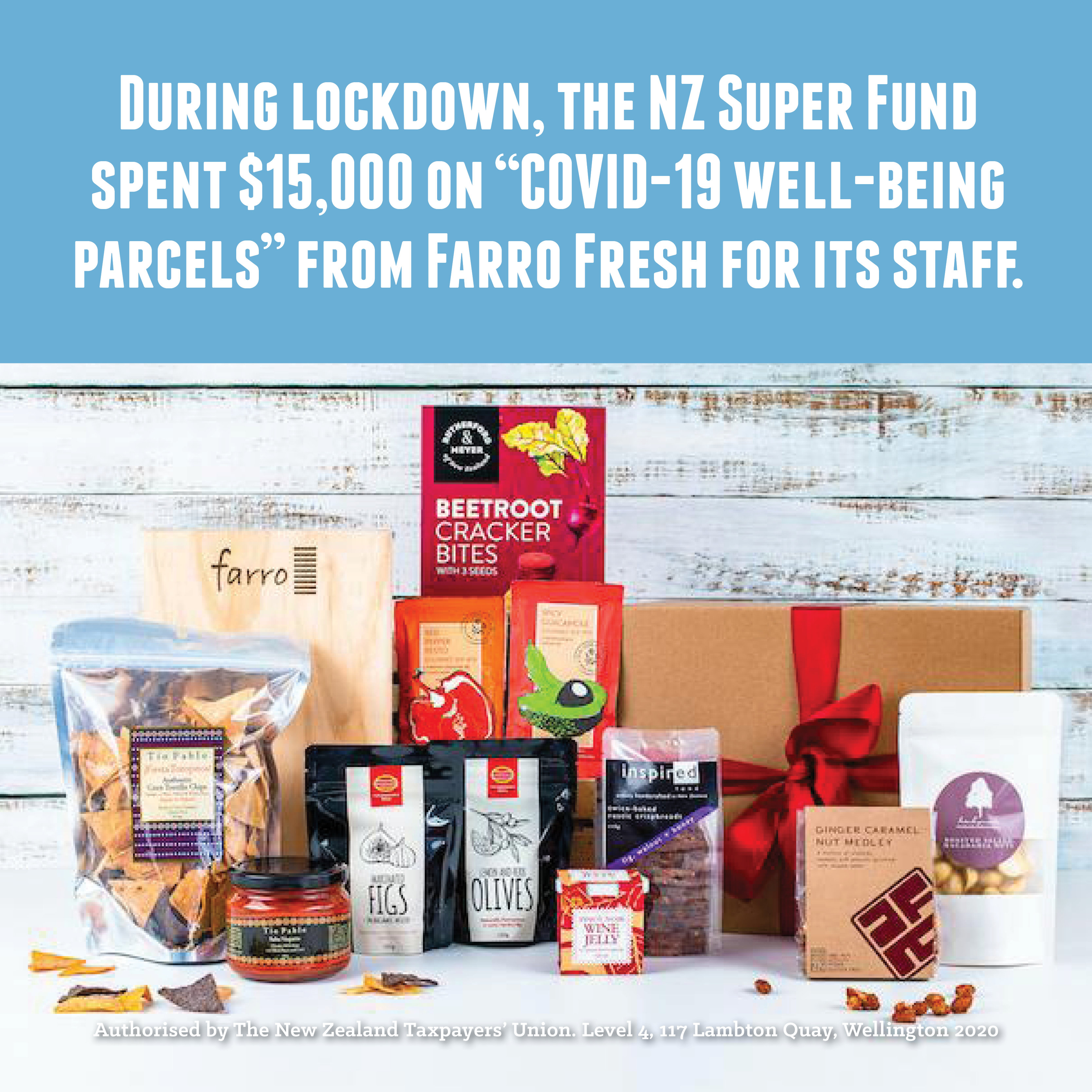
Revealed: Taxpayer-funded ‘wellbeing’ goodie bags during Lockdown Our research team recently revealed that the NZ Super Fund spent over $15,000 on “COVID-19 well-being parcels” from designer supermarket Farro Fresh for its highly-paid staff over lockdown.
According to NZSF, the parcels included ‘sundry goods’ such as coffee and hot cross buns.
Forty-five of the Super Fund’s staff are paid more than $300,000. Pretty much everyone else is paid more than $100,000 [and you thought KCDC salaries were excessive — Eds] . As I told the Herald, these people do not need care packages paid for by taxpayers who are going without during COVID-19 lockdown.
The Taxpayers’ Union requested the credit card statements of the NZSF from 1 March 2020 – 31 May 2020 under the Official Information Act. In addition to the goodie bags, other interesting payments included:
* Inspired Accountants team building trip for corporate strategy team for $1359.90 paid for during Level 3 Lockdown. * A canoe hire for $794.00. * Hand sanitiser for $568.80.
Renewal of a practicing certificate with the NZ Psychologists Board for $550.85.
A 10-year anniversary gift for a staff member for $515.Lunch at White & Wongs for $156 the day it was announced New Zealand would enter Level 4 Lockdown.“Motivation morning tea” before working from home for the investments team, for $107.61. Have a great week, Louis Houlbrooke Campaigns Manager New Zealand Taxpayers’ Union
No, this state isn’t having a bad resurgence of Covid — it’s only in nursing homes, with nursing home and medical staff and palliative care. The numbers of actual deaths are actually less than the flu, we don’t know if Covid was actually the cause of death and THERE IS NO FLU TESTING — only Covid testing. My 97-y-o grandfather died a few months ago with a list of health problems too long to name and we still can’t get an answer as to whether he was classified as a Covid death.



 The cozy deal between list MP Ginny Anderson (pictured above with the Debt Monster), the Labour Party, and the NZ Professional Firefighters Union is a rort on taxpayers.