A vaccine that increases the number of people who die is not working the way it should be. From The Exposé at the expose-news.com:
The Covid-19 injections were meant to reduce the sudden surge of deaths the USA recorded in 2020 due to the alleged Covid-19 pandemic. But unfortunately, the official figures prove that the opposite has happened.
Official reports quietly published by the United States Centers for Disease Control (CDC) confirm that over 6 million Americans have died ever since the U.S. Food & Drug Administration granted emergency use authorisation to a Covid-19 vaccine in December 2020; with 2021 being a record-breaking year for deaths.
This sadly means that at least 1.1 million Americans may have ‘died suddenly’ during this time frame because according to the CDC reports there have been 1,106,079 excess deaths compared to the 2015-2019 five-year average.
And with further official Government figures confirming that mortality rates per 100,000 are highest among the vaccinated population in every single age group, it would appear Covid-19 vaccination is almost entirely to blame.
“Instead of getting played like a didgeridoo by the Australian Government raiding New Zealand’s talent, Chris Hipkins should be telling New Zealanders how his Government will boost productivity and make New Zealand a greater place to live. Problem is Labour hasn’t any ideas to do that,” says ACT Leader David Seymour.
“We can have a better future in New Zealand, but at the moment the brutal truth is that money talks and many Kiwis finding it increasingly difficult to stay afloat in New Zealand will do what they have to do to get by.
“Under Labour the median wage gap has gone from Australians earning $17,400 more to $23,400 more. As well as earning more, people in Australia pay less. Interest rates are 1.5-2 per cent lower than New Zealand, and their Reserve Bank has stopped hiking the OCR. New Zealand mortgagees who refix this year will pay an extra $300-$400 per week.
“New Zealand’s falling wages reflect a long-term productivity decline. Lithuania, The Czech Republic, and Slovenia have all overtaken us for productivity in the past five years. We don’t even compare to Australia anymore.
“As we lose competitiveness, we lose skilled people and investment. As we lose skilled people and investment, we become less competitive. This is the spiral we must avoid. Do we want to carry on in comfortable decline until we slip away from first world status, or do we want real change?
“ACT says it is not enough to simply trim the sails when New Zealand is heading in the wrong direction. What is needed is a new direction, with real policy change for greater productivity. That includes:
Reducing Government waste to improve the quality of results from public services
Reducing taxes so more people keep more of what they earn to encourage upskilling, work, savings and investment
Increasing discipline on regulations so that people are not tied up in red tape
Setting high goals for educational success then trusting the profession to achieve them without micromanagement by the Ministry of Education
“ACT has set much of this agenda out in great detail. There are real alternatives available for New Zealand. ACT’s Alternative Budget for Real Change shows how to arrest the decline and grow the economy. It is needed reward Kiwis for their hard work by allowing them to keep their money. Under our plan a nurse with one child, for example, earning $70,000 would receive around $2,300 in tax relief. We would remove restrictions on investments from democratic OECD countries to bring more capital into the country.
“The Government’s approach is taking in record taxes to pay for wasteful spending. ACT’s approach is to take the foot off the throat of taxpayers and let them keep more of their money.
“People like to think of New Zealand as a first world country but our income figures tell a different story. Until we have a government focussed on economic growth we will continue to see tragedies in our health system, out of control crime, diminishing education standards and poverty.
“These challenges can be addressed, but in order to do that there needs to be a strong economy built around creating conditions for prosperity, giving people the opportunity to get ahead.”
We can expect that if votes to throw this government out in October don’t succeed, they’ll be followed by a lot of “voting with one’s feet.” —Eds
Hopping mad: covid-19 funding to ‘destroy’ wallabies for $153,000 a pop
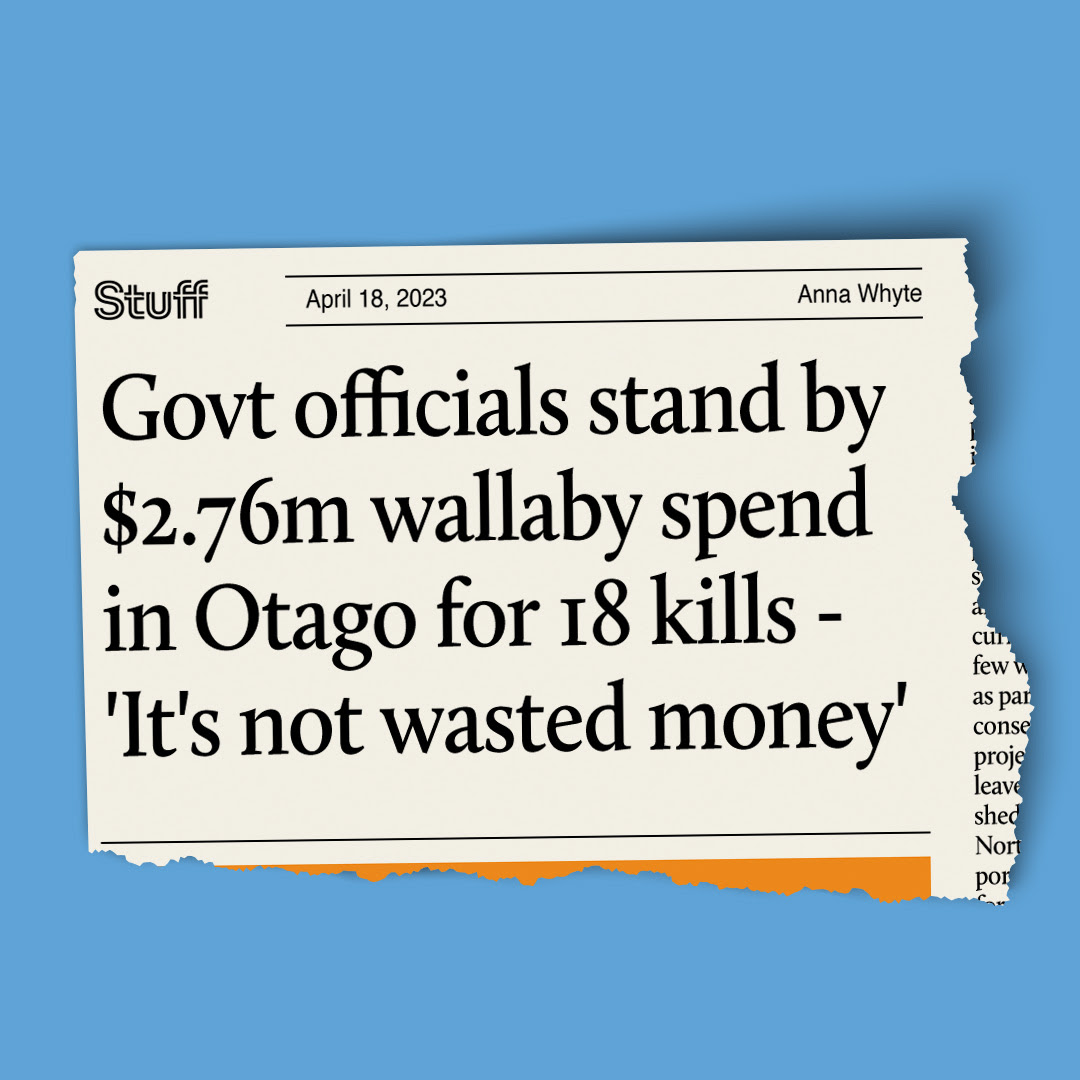
After almost six months’ worth of excuses, transfers and extensions on an Official Information Act request sent back in November, your humble Taxpayers’ Union has revealed that taxpayers and Otago ratepayers have forked out more than $2.76 million and employed over 26,000 hours of work to ‘destroy’ (that’s the term the bureaucrats use) just… 18 wallabies! That’s a kill cost of $153,000 per wallaby.
This was just one of the ‘Jobs for Nature’ projects funded by the covid slush fund. Jobs for Nature was allocated $1.2 billion – that’s $614 for every kiwi household – as a ‘make work’ scheme when the Government feared we would see mass job losses as a result of the pandemic.
Despite record-low unemployment and an economy overcooked by Government spending, the fund has continued to dish out taxpayer money to ineffective ‘conservation’ projects at an average cost of around $200,000 per ‘nature job’.
There is still $167 million yet to be spent: We say this should stop.
The story was also covered in the Otago Daily Times and Stuff’s Dominion Post.
Hopping to it: officials defend spending with misleading spin
John Walsh of Biosecurity New Zealand (the government agency responsible for this project) defended the spending arguing “it’s not wasted money”. Walsh was quoted in Stuff newspapers as saying the kill count no way represented “all the wallabies killed by the programme” and due to wallabies’ nocturnal nature and the remote landscapes, aerial drops were often the best method of killing.
We called out these misleading comments pointing to the official information response provided by his agency that showed that no aerial drops were actually used in Otago…
It is clear that this project, alongside many others supported through the Jobs for Nature fund, have no ambition in delivering meaningful outcomes for New Zealand’s environment on a restrained budget.
A lot more to come…
This is just our second investigation into this enormous fund. This is just the tip of the iceberg for a much greater raft of unnecessary waste…
A lesson from Northern Ireland: Where co-government often means no government at all
Writing in the New Zealand Herald, I looked at the system of “co-government” in Northern Ireland and considered the parallels with some of the recent proposals here in New Zealand. Three Waters, the proposed Resource Management Act replacement, and the Government’s so-called ‘Review into the Future for Local Government’ all reserve places on governance bodies for unelected mana whenua representatives.
There are two major problems with co-government models. First, is the creation of veto power. Where one community can block a proposal – even if it has majority support – simply because it disagrees with it. This veto power means that Northern Ireland is currently without a government and it is almost impossible to get anything done.
Secondly, there is the problem of disconnecting decision making from democratic accountability. By reserving spaces on governing bodies for certain groups, it means that, however they might vote in elections, people are not always able to effect meaningful change as the people making the decisions remain the same no matter how much voters disagree with their policies.
The lesson from Northern Ireland is, however well-intentioned, co-government rarely works in practice. It can bring government to a standstill, undermines democratic accountability, and often exacerbates the divisions it is designed to heal. If New Zealand wants to avoid similar paralysis, it should think twice before embarking on this path.
Councils funnelling millions into failing regional flight services
A Taxpayers’ Union investigation revealed that several councils are forking out millions of ratepayer dollars to subsidise a private airline and the wealthy individuals using it.
Across Kapiti Coast, Whakatane and Whanganui, ratepayers have been forced to foot the bill for more than $2 million in corporate welfare – benefiting only a tiny number of ratepayers who use the services. Since 2018, Air Chathams has been given almost $1 million dollars by Kāpiti Coast District Council along with a $500,000 interest-free loan. Whanganui and Whakatane district councils also coughed up hundreds of thousands of dollars in loans bringing the total value of welfare to more than $2 million.
Kāpiti Coast airport would need to see a 1,500 per cent increase in passengers in order for it to be financially viable, something even its own Chief Executive recognised.
In a blog post this week, one of our young interns, Alex Murphy, criticised the Council’s decision to fund these unsustainable routes and tears apart the report that supposedly provides economic justification for this wasteful example of corporate welfare. You can read the full post here.
The war in Gore: Mayor and CEO face-off
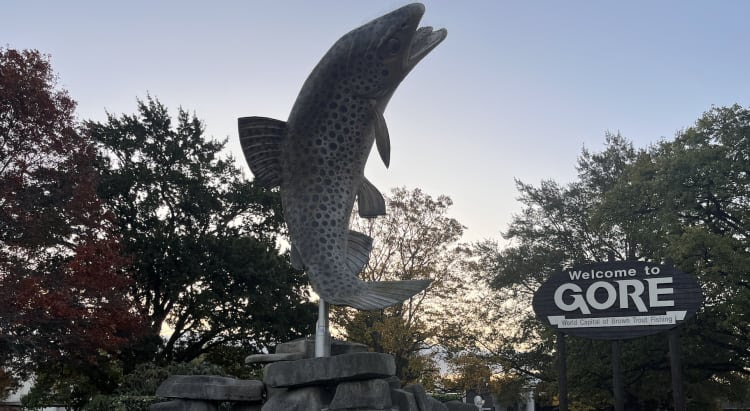
Like many, we’ve been following the events in Gore where the country’s youngest Mayor has had a ‘relationship breakdown’ with the Council’s CEO.
While it is difficult to know exactly what is going on at the Council, we’ve been astonished by the willingness of the CEO – an unelected bureaucrat – to air his dirty laundry in public by speaking to multiple media organizations. The role of public servants is to serve the public by implementing the policies of their democratically elected representatives – not obstruct them and then bad mouth them in public.
Taxpayers’ Union Campaign Manager Callum Purves says the Taxpayers’ Union wants to see an option of recall elections introduced so that, if people are unhappy with the performance of a mayor or councillors that there is a mechanism by which they can resolve it without having to look at something like commissioners or some external influence.
And if conflict between a council chief executive or local body politician is unable to be resolved the Taxpayers’ Union is quite clear who should resign.
“Ultimately in a democracy if there is also a conflict between elected representative and officials, so in this case we have a conflict between the mayor and the chief executive, that we are strongly of the view that the elected representative is the one that stays if there is a choice,” says Purves.
Taxpayer Talk: ACT MP Simon Court on Three Waters and the proposed RMA reforms
This week on Taxpayer Talk, I sit down with ACT Party MP, Simon Court, to discuss the recent Three Waters rebrand, the proposed resource management reforms and what ACT is proposing to solve New Zealand’s significant infrastructure and planning problems.
Simon Court is ACT’s spokesperson for infrastructure, the environment and local government and has been leading their response to the contentious Three Waters and RMA reforms. Prior to becoming an MP, Simon was a civil and environmental engineer working both in the private sector and for local government. Simon believes that local control, strong private property rights and the right incentives for councils to make good decisions will be what leads to solving some of our biggest problems going forward.
Later in the podcast, for our War on Waste segment, Taxpayers’ Union Deputy Campaigns Manager, Connor Molloy, reveals a 19-month long investigation into the Government’s decision to give millions of taxpayer dollars to a gang-affiliated meth rehabilitation program and the bureaucratic process of simply getting straight answers from officials.
It is [14] months since a team of 3 officers acted together in a way that broke my sternum and then 2 more officers twisted my arm up behind my back (despite me clearly being in agony and telling them loudly and clearly that my sternum, had just been broken by a police officer ( I didn’t see at the time the two male officers who were applying force behind the female.)
Despite having video of what happened from 3 angles. Despite having a POLICE investigation and an IPCA ( Independent Police Conduct Authority) investigation, I still do not have the name or number of a single officer involved.
So how do I seek remedy?
Under Magna Carta we all have equal standing and rights under the law — if I had assaulted a police office I would be in court pronto. Justice should not be delayed – but it is being delayed in this case and so their wrongdoing is being compounded.
And no, I had not been arrested, no I was not breaking any laws. I was stood peacefully with my arms interlinked with people either side of me. After getting assaulted I cried out for medical treatment — but instead this is what happened.
Will he get the nomination? The Leftist establishment doesn’t like him at all, but it will be up to voters, Polls show an overwhelming majority of Americans have had enough of Joe and his minions.
The Ministry of Health is running online polls and then paying for them to be promoted to people explaining how the health system is in crisis. pic.twitter.com/n2CP5n9WOn
Fall in at 10:45 am at the Waikanae Club on Elizabeth Street. March to the Waikanae Memorial Hall for a service at 11:00 am.
Remember that respecting the sacrifices made by our servicepeople in foreign wars does not mean respecting the conflicts themselves. War is horrible and there is nothing glamorous about it.
Now fallen into shadow, the Romania-born Baron Franz Nopcsa was a groundbreaking scientist, adventurer — and would-be king.– Journalist Vanessa Veselka
By Bob Brockie
Aristocrat, Nationalist and spy
Baron Nopsca was brought up in a Transylvanian castle in Hungary in the 1870s. Over many years, the Austro-Hungarian empire sought to overthrow the Ottoman Turks in the Balkans. and, posing as a Transyvanian shepherd, Nopsca acted as a spy for Austro-Hungary. He spent time in the Albanian mountains, smuggled weapons and made passionate speeches promoting Albania’s independence.
As a result of the wars, Albania became an independent nation looking for a king. Nopsca offered to fill the post and proposed overcoming the country’s poverty by marrying an America heiress. Nothing came of his suggestion.
After World War One Transylvania was ceded to Rumania and Nospsca lost his estates and fortune. Throughout his life, the baron rode everywhere on a motorbike, accompanied by his ‘secretary’ and lover Bajazid Doda, an Albanian Muslim.
Nopsca and science
As a young man, Nopsca found several fossil dinosaurs on his family estates. He consulted specialists at the Vienna University who encouraged his curiosity and which eventually earned him a doctorate, based on the many fossil dinosaurs he discovered.
Not content with simply naming his dinosaurs, Nopsca tried to put flesh on their bones by speculating about their physiology and behaviour. Most of his finds were of dwarf dinosaurs that he showed once lived on islands and were social animals.
Baron Nopsca:
specialised in fossil cousins of our tuatara (Rhynchocephalia)
drew the first geological maps of Albania
was appointed Director of the Royal Hungarian Geological Institute in 1925. He worked prodigiously, confirming Wegener’s theory of continental drift.
An unhappy ending
One fine day, Nopsca set about a 6,000 km ride through the Alps and the length of Italy along the Adriatic coast, visiting its many fossil sites and collecting a huge amount of information. Returning to Vienna the baron started analysing his findings but fell ill and lethargic.
His illness led to painful convulsive attacks and depression. Suicidal, Nopsca shot and killed his lover Doda, then himself at age 55.
In geological circles, Franz Nopsca von Felsö-Szilvàs is still known as the ‘Father of palaeobiology’.
Jacinda Ardern has just been been appointed a trustee of the Prince of Wales’ prestigious environment award, “The Earthshot Prize” created by Prince William to fund projects that aim to save the planet.
Prince William was effusive and glowing about the former New Zealand Prime Minister’s “life-long commitment to supporting sustainable and environmental solutions”.
And the former prime minister said she was “humbled and excited to be working with the Earthshot team”.
Prince William said Ms Ardern’s and her experience would “bring a rich infusion of new thinking to our mission”. Chair of the board of trustees Christiana Figueres said she was “thrilled” to welcome Jacinda Ardern and had long been inspired by her “work as a catalysing force in the effort to combat climate change”.
But there are big question marks about Ardern’s record
Examination of her track record as Prime Minister don’t bear out the ecstatic enraptured description of Jacinda Ardern as an environmentalist.
Dan Wooton writing in the Australian Daily Mail said he feared “William has made his first mistake as Prince of Wales by aligning himself so closely with one of the world’s more divisive politicians.”
Wooton based his horror at Ardern’s “Earth Planet” appointment on her “brutally inhumane lockdown regime” around Covid describing the retired prime minister as “heartless.”
But I wish to leave Covid aside and focus on the relevance of Jacinda Ardern’s prestigious appointment to Prince William’s Earth Planet and her qualifications as an environmentalist.
There’s nothing in her academic qualifications – “Ardern attended the University of Waikato, graduating in 2001 with a Bachelor of Communication Studies in politics and public relations, a specialist three-year degree.”
So how did she fare environmentally in her six years as prime minister 2017 to 2023?
Not at all good — in fact badly.
Jacinda Ardern as an environmentalist fails badly.
Looking at some issues, naturally climate change is one to focus on, which significantly has usurped the original name of global warming.
Her climate change commitments are a full of contradictions and hypocrisy. As one critic has said “Her climate change commitments are a joke.” She closed down coal mining in New Zealand and “then presided over the largest imports of coal we have ever seen, into a country that is sitting on huge coal reserves.”
Ardern’s Emissions Trading Scheme (ETS) is illogical, rejecting any vegetation under five metres in height for carbon sequestering assessment, when several dozen New Zealand native tree species are five metres or less. Her administration absurdly rejects the undeniable fact that all trees that are above five metres in height had for several years or more as juveniles, been under five metres in height. This wacky thinking similarly rejects farmers’ pasture in sequestering values.
Then in the next breath, her government has lambasted farmers for stock flatulence.
The Government, presided over by Jacinda Ardern for six years, sees carbon credits as the solution, a sort of free market trading, wheeling and dealing whereby a major polluter can excuse its gross pollution by planting a monoculture of trees elsewhere. How one country or corporate company paying another for the right to continue polluting is supposed to save Planet Earth, escapes me.
Carbon Trading
The approach of the Ardern governments to the theoretical threat of climate change has been to open investment doors to foreign carbon trading “farming” speculators of the corporate kind. Let me make it clear, I’m not anti-forestry. I think integrated, coordinated farm-forestry is excellent. But Jacinda Ardern’s carbon farming is futile, farcical and environmentally foolish.
Any farmer wishing to integrate trees on farms is commendable and deserves incentives. Trees absorb carbon dioxide and that’s good for both climate and environment to plant forests in the right place.
The problem is, if unchecked, uncoordinated carbon farming, gives rise to vast monocultures of trees that will probably never be harvested and used for timber.
As Beef+Lamb New Zealand says “the NZ Government is economically incentivising wholesale land use change from pastoral-based farming into exotic trees – because the increasing price of carbon credits is distorting what land is worth and productive farmland is being sold, often to overseas buyers, for the future planting of trees – mainly exotic species such as pinus radiata.”
The Government carbon farming scheme is a mess. It has failed to set any target to reduce absolute emissions from fossil fuel use, and has not set any limits on how much offsetting of emissions can happen through the ETS to meet our climate change targets and therefore on how much land should be converted to forestry to create carbon credits for sale.
I see no benefit from carbon trading.
I once asked a professional forester his opinion of carbon trading. He described it as “a rort” on the country economically. It is worsened by the move by the Ardern administrations to ease any controls on foreign investment – or should it be intrusion – by carbon farming speculators from overseas. As my forester friend described, the economic angle with profits flowing offshore to foreign investor head offices and shareholders, is a rort economically.
It is also a rort environmentally.
Drying up rivers
As a long-time fly fisherman, I know one or two trout streams. I went to fish one last autumn and to my astonishment found the stream bed bone-dry, whereas the stream once flowed all year round even in dry, drought summers.
The reason was a monoculture of pines. Now pines have an unquenchable thirst for water and as they grow they thirst for more and more water. The thirst is insatiable. And this stream’s catchment was largely planted in a monoculture of pines in this case for production forestry.
But Ardern has presided over a mania for pine monocultures of the carbon farming type that threaten to overwhelm whole valleys as overseas speculators are welcomed and flood in.
Highly productive beef and sheep farms have succumbed to market values as they are converted to the mania of carbon farming.
Monocultures of pine forests are of dubious environmental value, particularly “carbon farming”
Anti-Environment – doing nothing about cleaning up rivers
Pine forests are of dubious environmental value. They induce acidification of soil and run-off with a loss of bio-diversity. Freshwater aquatic biodiversity is reduced as acid water means lower aquatic invertebrate populations, which means a loss of sporting fish species like trout and indigenous fish species.
The ill-effects cut deeper into the social fabric of rural New Zealand. Converting productive farmland to pine plantations for carbon credits means depopulation as farmers leave. Farm employment drops or disappears and further depopulation occurs in small towns as there is less demand for local contractors, businesses, schools and services essential for farming.
In August 2017 leading up to that year’s election, Jacinda Ardern pledged Labour would lead a nationwide effort to restore deteriorated rivers and lakes to a clean, swimmable state. By early 2020 little or nothing had been done. Greenpeace challenged PM Ardern with “It’s time for the Prime Minister to make good on her (2017) promises to clean up our rivers.”
In 2020 Jacinda Ardern renewed her promise to clean up rivers. Months later the ABC reported “New Zealand’s clean, green image hides a dirty truth. Polluted by intensive dairy farming, its waterways are some of the most degraded in the world.”
Then it asked “will the Ardern government clean it up?” To be fair, the origin of the state of rivers was nothing to do Jacinda Ardern-led governments. However Labour has not stopped the degradation of waterways.
Key Grilled
The deterioration started well before 2017.
In 2011 Prime Minister John Key and New Zealand’s environmental record were put under the spotlight in an interview on the BBC programme Hardtalk as BBC journalist Stephen Sackur grilled him about whether New Zealand really is as clean and green as the country’s tourism campaign claimed. Sackur cited Mike Joy, a leading environmental scientist at Massey University, who had said “we are delusional about how green and clean we are”.
Mike Joy made the comment while pointing out that many New Zealand species were facing extinction and more than half the countries lakes and low-land rivers were polluted. Key denied it but Sackur pointed out that Mike Joy was a scientist and would have based his comments on research.
Nevertheless in 2017 and then again in 2020 prior to elections, Jacinda Ardern promised to clean up the deteriorated rivers. Her government failed both times.
Dangerous Nitrate Levels
During the Ardern years, more emerged on the environmental state of New Zealand’s rivers. The NZ Federation of Freshwater Anglers, a rivers and trout and salmon advocacy group, carried out nitrate testing which revealed excessive levels of the chemical mainly due to corporate dairying.
The high nitrate levels are toxic to aquatic life but also to human health with the Canterbury — South Canterbury people revealed as having bowel cancer levels among the highest in the world. A Danish study of 2.7 million people revealed a strong, undeniable link between high nitrate levels in drinking water and bowel cancer.
But the Ardern years have been compliant in other environmental failings. Native birds have suffered from widespread government use of indiscriminate toxins like 1080 spread by air over public lands. Native bird numbers have suffered with some species such as the native kea parrot plummeting downwards to endangered status.
Corporate Domination
Sea fisheries dominated by a free market quota approach has resulted in corporations dominating the fishing industry with the government’s fisheries ministry seemingly sanctioning commercial methods. Bottom trawling and dredging has been allowed to continue damaging seabed environments and upsetting saltwater ecosystems.
Lax foreign ownership controls have allowed corporates to ease in and gain control such as Chinese acquisition of vertically integrated dairying from farm to processing to supply.
Counter Productive Law
Then there were other issues like Jacinda Ardern’s panicked law following the 2019 mosque shooting by an Australian terrorist. The rushed law targeted the lawful firearm owning public and left the gangs and criminals better armed. New Zealand is a land of outdoor pursuits, among it hunting. But under an inept Department of Conservation, surely a misnomer in title, animals such as the world rare Himalayan tahr are slaughtered by government programs. Game management is virtually unknown.
Therefore is it any wonder that many New Zealanders are puzzled and some aghast at Jacinda Ardern’s appointment as a trustee to Prince William’s Planet Earth concept? It seems Prince William’s researchers failed to do their homework.
Tony Orman is an angler, hunter, a conservationist and a swinging voter who was involved in “Save Manapouri” battle around 1970 and has been a forthright environmental advocate ever since.