Consider the lilies, how they grow: they neither toil nor spin, yet I tell you, even Solomon in all his glory was not arrayed like one of these. –Luke 12.27
Springtime — a Season to Cherish
Six years ago we were in Christchurch catching up with family and friends. It was great time to go, because in a city that has been through so much in recent decades springtime is probably more vivid and vibrant than in any other place in the country.
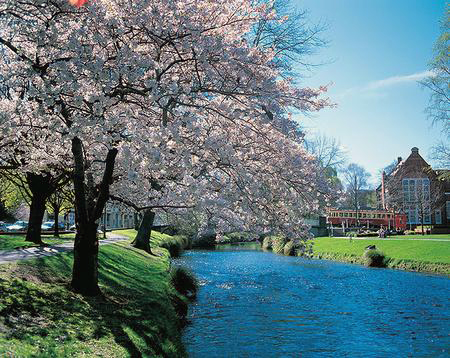
Hagley Park is the show piece at this time of the year, as there are thousands of daffodils, snowdrops and bluebells flowering along the many grassy verges especially by the Avon River. Then there are the cherry tree blossoms, notably on either side of Harper Avenue which runs through North Hagley Park on the edge of Merivale.
Trees that never disappoint
From our kitchen window we look out at trees of many colours. However, at this time of the year the deciduous species are the most fascinating. We eagerly await the blossoming of two prominent cherry trees close by.
Soon there will be more leaves or flowers, or both. Spring is a wonderful season for change in nature as there is new growth, especially if there is a plenty of rain as well as warmth. There is plenty of growth of vegetables, fruit trees, shrubs and flowers but also grass and weeds!
It can galvanise us into the well-named “spring clean” and it is a good time for clearing out rubbish and junk, weeding gardens and planting flowers. trees and vegetables.
The budding and flowering of the trees is a magical experience and always occurs in sequence. Waikanaens who regularly drive along Te Moana Road will know that the roadside trees blossom in a particular order which never changes. It’s certainly good to have some predictability and continuity in changing and uncertain times.
Kowhai flowers and tui
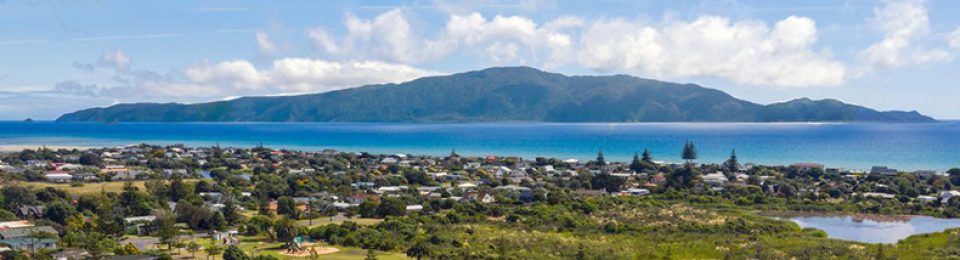
From our conservatory we can view a kowhai tree which is about six metres wide. In spring kowhai trees and the parson birds are synonymous and enjoy a symbiotic relationship. A couple of days ago we sat and watched up to twelve tui tearing into the flowers for the nectar they produce.
It’s a fabulous sight especially seeing the birds turn upside down to extract the golden juice. They are not particularly friendly and squabbles frequently break out making it difficult to do accurate counts of these amazing birds.
Some of our leaders openly support the anti-Semitic narrative of “From the river to the sea”.
That got me thinking of the very demographic that largely supports this evil narrative. The Greens are the largest support base of launching into the Jewish solution with conviction while sharing Uncle Bully’s potential DNA markings.
What is a little shocking is the DNA test of the gaslighting king: Uncle Bully Jackson is 25% Jewish
This has been professionally tested and a small documentary can be found on Uncle Bully’s test results. Facts matter when Cultural Desolation is being chanted by the leaders and very demographic of Kiwis that are likely to share those same ancestors.
When is leadership going to stop gaslightproclaiming pure blood quantum over the reality that there are over 180+ representive languages of New Zealand? All Kiwis including “Māori ” are mixed race, all Kiwis are equal under the sovereignty of democracy.
The Local Government (System Improvements) Amendment Bill has now passed its third reading, and has become law — signalling a clear shift in direction for local government.
The changes make it clear the purpose of local government is to focus on the provision of infrastructure, public services and regulatory services (such as dog control) – and to support the development and growth of the region by doing things well. Councils are required to focus on the following core services to its communities: network infrastructure, public transport services, waste management and minimisation, civil defence emergency management and libraries, museums, reserves, and other community and recreational facilities.
That’s it. That’s what Parliament has decided should be the role and focus of KCDC and all other local Councils. To make its intent really clear, the new legislation also removes the four “well-beings” from the statutory purpose of local government.
The Aill also makes an important democratic change: non-elected members of council committees will generally no longer have voting rights.
In addition, most political parties are now lining up behind the rates capping proposal.
NOW COMES THE TEST FOR KCDC.
This afternoon (22nd September), KCDC Councilors are meeting to consider the feedback received during its latest engagement on the Long-term Plan 2027–37.
So what will the Council do?
Will it take the new direction seriously and put core services, affordability and sound financial management first?
Or will ratepayers continue to see money directed into an ever-expanding range of social, environmental, cultural and economic development initiatives?
Our recent article on rates capping highlighted the issue of out-of-control spending. And in an earlier article, we debunked Council’s argument that rising costs above CPI automatically justify continued high rates increases.
The reasons that KCDC has used in the past to justify high rates increases have been shown not to stack up. And now the Government has now made its direction of what it wants from local government much clearer.
Will KCDC follow that direction — or continue with business as usual?
We’ll be speaking at today’s full Council meeting starting at 1.30 pm and will be watching closely what they do from here.
You should too.
Attend if you can, or watch the meeting online. Council provides agendas, livestreams and recordings through its meetings page.
Approved by the National Assembly of France, August 26, 1789
The representatives of the French people, organized as a National Assembly, believing that the ignorance, neglect, or contempt of the rights of man are the sole cause of public calamities and of the corruption of governments, have determined to set forth in a solemn declaration the natural, unalienable, and sacred rights of man, in order that this declaration, being constantly before all the members of the Social body, shall remind them continually of their rights and duties; in order that the acts of the legislative power, as well as those of the executive power, may be compared at any moment with the objects and purposes of all political institutions and may thus be more respected, and, lastly, in order that the grievances of the citizens, based hereafter upon simple and incontestable principles, shall tend to the maintenance of the constitution and redound to the happiness of all. Therefore the National Assembly recognizes and proclaims, in the presence and under the auspices of the Supreme Being, the following rights of man and of the citizen:
Articles:
1. Men are born and remain free and equal in rights. Social distinctions may be founded only upon the general good.
2. The aim of all political association is the preservation of the natural and imprescriptible rights of man. These rights are liberty, property, security, and resistance to oppression.
3. The principle of all sovereignty resides essentially in the nation. No body nor individual may exercise any authority which does not proceed directly from the nation.
4. Liberty consists in the freedom to do everything which injures no one else; hence the exercise of the natural rights of each man has no limits except those which assure to the other members of the society the enjoyment of the same rights. These limits can only be determined by law.
5. Law can only prohibit such actions as are hurtful to society. Nothing may be prevented which is not forbidden by law, and no one may be forced to do anything not provided for by law.
6. Law is the expression of the general will. Every citizen has a right to participate personally, or through his representative, in its foundation. It must be the same for all, whether it protects or punishes. All citizens, being equal in the eyes of the law, are equally eligible to all dignities and to all public positions and occupations, according to their abilities, and without distinction except that of their virtues and talents.
7. No person shall be accused, arrested, or imprisoned except in the cases and according to the forms prescribed by law. Any one soliciting, transmitting, executing, or causing to be executed, any arbitrary order, shall be punished. But any citizen summoned or arrested in virtue of the law shall submit without delay, as resistance constitutes an offense.
8. The law shall provide for such punishments only as are strictly and obviously necessary, and no one shall suffer punishment except it be legally inflicted in virtue of a law passed and promulgated before the commission of the offense.
9. As all persons are held innocent until they shall have been declared guilty, if arrest shall be deemed indispensable, all harshness not essential to the securing of the prisoner’s person shall be severely repressed by law.
10. No one shall be disquieted on account of his opinions, including his religious views, provided their manifestation does not disturb the public order established by law.
11. The free communication of ideas and opinions is one of the most precious of the rights of man. Every citizen may, accordingly, speak, write, and print with freedom, but shall be responsible for such abuses of this freedom as shall be defined by law.
12. The security of the rights of man and of the citizen requires public military forces. These forces are, therefore, established for the good of all and not for the personal advantage of those to whom they shall be intrusted.
13. A common contribution is essential for the maintenance of the public forces and for the cost of administration. This should be equitably distributed among all the citizens in proportion to their means.
14. All the citizens have a right to decide, either personally or by their representatives, as to the necessity of the public contribution; to grant this freely; to know to what uses it is put; and to fix the proportion, the mode of assessment and of collection and the duration of the taxes.
15. Society has the right to require of every public agent an account of his administration.
16. A society in which the observance of the law is not assured, nor the separation of powers defined, has no constitution at all.
17. Since property is an inviolable and sacred right, no one shall be deprived thereof except where public necessity, legally determined, shall clearly demand it, and then only on condition that the owner shall have been previously and equitably indemnified.
Parliament will finish its three-year term on Wednesday with the resource management bills to replace the RMA being passed on Tuesday. Replacing the RMA with the Planning Act and Natural Environments Act, based on property rights, is a major ACT triumph.
The success of our society rests on the ability to own land and develop it freely if your activity doesn’t harm others, but the RMA has stifled New Zealand for years. ACT’s Simon Court has been driving the change for three years and Tuesday will be a major milestone for the Party and for New Zealand.
Now the focus turns to winning power so the second layer of guidance below the Parliamentary law, the directions and policy statements, will be done in a way consistent with the principles ACT has championed.
Welcome to Wonderland
New Zealand has always needed ACT, and ACT needs your Party Vote. You’d expect us to say that, but in the last week it’s taken on new urgency.
Poor productivity growth and high inflation have meant wages have struggled to keep pace with inflation lately. The cost of living is the number one concern for voters, but it’s really a productivity vs inflation problem.
It’s a problem that deserves serious attention. Why is New Zealand not getting the investment and innovation required to boost real wages ahead of inflation? How can the faith of the disillusioned be restored, so that property rights, the rule of law, and markets can be politically sustainable? Those are the questions that require urgent attention.
Unfortunately, nobody on the political spectrum (other than ACT) is asking these basic but important questions. Instead, this has happened:
Weak wage growth and high inflation mean families feel the pinch, and the checkout has become the rallying point for this concern. That’s where people hand over money every week for items they can’t avoid buying, so the concern is the most acute.
Political parties ask focus groups and they’re told ‘do something about the supermarkets!’ Instead of analysing the problem, every political party besides ACT is competing to do the most dramatic thing to the supermarkets, regardless of whether it will work or what else it will do to our country.
It is a tragic and immature scene. The Greens’ policy of nationalising a third of the industry and running it from the Beehive is the nuttiest, just. Labour’s structural separation is, surprisingly, the least nutty, but still involves expropriating private property to restructure an industry. If their restructuring of the health system is anything to go by, it will make groceries more expensive.
New Zealand First have long supported populist policies including ‘breaking up supermarkets,’ and often have economic policies not far from the Greens, if you strip away the rhetoric. What’s surprising is the National Party have now copied the New Zealand First policy, leaving ACT alone to defend private enterprise.
New Zealand is a small market far away from everything, but we have the second highest living standards in the Southern Hemisphere (and third place is not even close). Our inherited British legal and political system, frustrating as it can be sometimes, makes this possible.
Secure property rights under the rule of law mean investment is subject to commercial risk, but not political uncertainty. Every other party is now irresponsibly putting that at risk for what they think will be short-term political gain.
It is not only the policies that are the problem, it is the sense of political panic that is behind them. Any vaguely sensible investor inside or outside New Zealand is going to assess the ‘sovereign risk’ of investing here, and that risk went up this week.
The ACT Party proudly stands for the traditions that made this country a success, keeping our heads when others are losing theirs. The Party has stopped knee-jerk interventions this term, and will do it again if in Government again.
Then the focus should turn to the underlying problem. Why has monetary policy been too loose, letting inflation get out of control this decade? Why has productivity growth been so slow, eroding voters’ confidence that hard work is a good strategy and life can get better?
Free Press readers know the answer. If a country spends 20 years introducing new laws and regulations that add cost without generating revenue, then people will be poorer.
You can have 10 days’ sick leave, Mondayised public holidays, and an extra public holiday, climate reporting, earthquake strengthening, the Health and Safety at Work Act, and racial quotas for Government tenders, (and on it goes) but don’t be surprised if there’s not much left for wage growth.
If the Government’s own consumption grows and takes more without producing more, then the tax on productive people will be higher. That’s both literal taxes and interest being higher as a Government in deficit competes with business to borrow loanable funds.
It has received only 4.9% of the vote, below the 5% threshold so his Weltkrieg III (World War III) a..k.a. CDU party is out. The AfD is the largest party — Nato warlords will be wringing their hands and nashing their teeth!.
MERKEL’S LEGACY IS DEAD.
Merz’ and Merkel’s party CDU suffers the greatest loss in history: 4.9%.
That means they’re OUT. No state parliament representation.
One of my cousins has just returned from a 7-week vacation in Europe and was unimpressed with the experience in Merz’s 4th Reich — “We travelled by rail quite a lot. The TGV from Paris to Milan was the pick of the routes , followed by the Eurostar from Cologne to Paris. Deutsche Bahn was, surprisingly, the worst. The train from Copenhagen to Hamburg broke down and we had to finish the trip by bus. The train from Hamburg to Cologne was late and did not stop at the Cologne Central station where is was supposed to causing us to have to catch a local train from the next place it stopped at.”
The complete neglect of Germany’s pressing infrastructure needs by the 4th Reich regime and its obsession with conquering Ukraine, then Russia, for BlackRock and other Globalist corporations has upset a big percentage of the German public, it’s probable that this will intensify as things get worse.
The Kanzler’s CDU is on course for its worst-ever state showing in Mecklenburg-Western Pomerania and trails the Left in Berlin
German Chancellor Friedrich Merz has described his Christian Democratic Union’s performance in Sunday’s state election in Mecklenburg-Western Pomerania as a “disaster,” after preliminary results showed a historic low for the party. The CDU has fared better in Berlin, but its result there still appears to have dashed its hopes of leading the next government.
The CDU received just 5.5% of the vote, according to an ARD exit poll, its worst results in a state election since the founding of the federal republic in 1949. This leaves the party just above the 5% threshold required to enter the regional parliament.
“The result in Mecklenburg-Western Pomerania cannot be talked away, it’s a disaster,” Merz acknowledged during a press conference on Sunday evening. However, he still defended his government’s course, insisting that there “cannot be a return to the good old times.”
The Alternative for Germany party (AfD) is leading with 37%, ahead of the ruling Social Democrats (SPD) at 35.5%, according to the poll.