Carrying on Tova’s legacy.

29 Thursday Jun 2023
Posted in Uncategorized
Carrying on Tova’s legacy.
29 Thursday Jun 2023
Posted in Uncategorized
“You see heaps and heaps of the birds’ bones in archaeological site. If you hunt animals at all their life stages, they will never have a chance.” –Morten Allenton, an evolutionary biologist at the University of Copenhagen
By Tony Orman

Exterminating the giant bird
The rapid extinction of the several moa species from New Zealand has long been debated. Some, in defence of the early Polynesian migrants who had arrived about 1250, have said the flightless bird numbers were already in decline. The Polynesian migrants were conservationists it was claimed.
In 2014, scientists investigated further and concluded humans were the sole factor in wholesale killing of the birds and in destruction of habitat. Strangely their findings received little media coverage at the time.
But the reality was that moa were obliterated in a geological “blink of the eye” — just one or two centuries.
The end for the moa was devastatingly fast.

Yet before that, for probably 50 or 60 million years, nine species of large, flightless birds known as moas (Dinornithiformes) thrived in New Zealand. About 600 years ago, moa suddenly became extinct. Their disappearance had coincided with the arrival of the Polynesian migrant humans to New Zealand somewhere in the late 13th century.
Scientists since have long wondered what influence humans played in the decline and extinction.
Others argued the moa was on the way out — naturally — and humans were not responsible.
But the question nagged. Were humans the principal factor? Even the one and only factor?
Then again, or were moa numbers in decline and moa doomed to extinction anyway due to disease and volcanic eruptions? Scientists went into study mode.
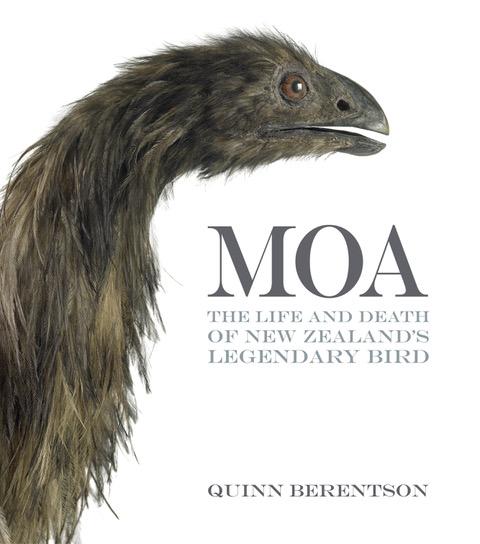
A recent and very impressive book on the moa by publishers Potton and Burton of Nelson. (The book was first published in 2012.)
Convincing Case
The conclusions were summed by a Spanish evolutionary biologist. They were emphatic.
“The paper presents a very convincing case of extinction due to humans,” said Carles Lalueza-Fox, an evolutionary biologist at the Institute of Evolutionary Biology in Barcelona, Spain. “It’s not because of a long, natural decline.”

One of the researchers Morten Allentoft, an evolutionary biologist at the University of Copenhagen, outlined the logic behind the research group’s conclusions. Archaeologists know that the Polynesians who first colonised New Zealand, ate moa of all ages, as well as the birds’ eggs.
“You see heaps and heaps of the birds’ bones in archaeological sites,” Allentoft said. “If you hunt animals at all their life stages, they will never have a chance.”
Using ancient DNA from 281 individual moa from four different species, including Dinornis robustus (at 2 metres, the tallest moa, able to reach foliage 3.6 meters above the ground) and radiocarbon dating, Allentoft and his colleagues set out to determine the moa’ genetic and population history over the last 4000 years. The moa bones were collected from five fossil sites on New Zealand’s South Island, and ranged in age from 12,966 to 602 years old. The researchers analysed mitochondrial and nuclear DNA from the bones and used it to examine the genetic diversity of the four species.
The research team’s analysis found no sign that the moa’s population had already been collapsing when the Polynesian colonists settled New Zealand. Indeed, the scientists concluded that the opposite was true – bird numbers were stable during the 4,000 years prior to extinction.
Populations of D. robustus even appeared to have been slowly increasing when the Polynesians arrived.
Yet in less than 200 years later, the birds had gone. “There is no trace of their pending extinction in their genes,” Allentoft said. “The moa are there, and then they are gone.”
Humans alone killed off the moa
Trevor Henry Worthy is an Australia-based paleozoologist from New Zealand, known for his research on moa and other extinct vertebrates.
He commented that the Copenhagen University paper presented an “impressive amount of evidence” that humans alone drove the moa extinct. Trevor Worthy, an evolutionary biologist and moa expert at Flinders University in Adelaide, Australia, was independent i.e. not involved in the official research.
“The inescapable conclusion is these birds were not senescent, not in the old age of their lineage and about to exit from the world. Rather they were robust, healthy populations when humans encountered and terminated them.”
At the time he expressed doubts that even the Copenhagen University’s team’s “robust data set” would settle the debate about the role people played in the moa’s extinction, simply because “some have a belief that humans would not have” done such a thing.
Human Tendency
Copenhagen University’s Morten Allentoft, said he was not surprised that the Polynesian settlers killed off the moa. The reality is any other group of humans would have done the same, he suspected.
“We like to think of indigenous people as living in harmony with nature,” he said. “But this is rarely the case. Humans everywhere will take what they need to survive. That’s how it works.”
In late 2014 New Zealand scientist Richard Holdaway, (a specialist in extinction biology), Copenhagen University’s Morten Allentoft and four other scientists completed a study entitled “An extremely low-density human population exterminated New Zealand moa.”
They concluded: “New Zealand moa (Aves: Dinornithiformes) are the only late Quaternary megafauna whose extinction was clearly caused by humans. Polynesians exterminated viable populations of moa by hunting and removal of habitat.”
29 Thursday Jun 2023
Posted in Uncategorized

I want to share an incredible story that highlights the importance of medical autonomy and individual choice. It revolves around Dr. Elena Bishop, a pathologist who found herself arguing for her medical rights and the extenuating circumstances of her situation.
In this article on the blog, we delve into Dr. Bishop’s story of how she risked everything when she spoke for informed patient consent and the right to decline medical treatment.
Despite the fact that her job did not require direct contact with patients or fellow doctors, she was unjustly prohibited from practicing–even after proactively working with her boss to set up a work-from-home environment.
Dr. Bishop’s story highlights the broader issue of medical autonomy and the right to choose or refuse treatment based on informed consent.
It also raises concerns about the suppression of important voices in the medical community.
To read the full blog post and learn more about Dr. Elena Bishop’s resilience, click here.
 Anna McLoughlin, NZDSOS Communications Team Anna McLoughlin, NZDSOS Communications Team |
29 Thursday Jun 2023
Posted in Uncategorized

29 Thursday Jun 2023
Posted in Uncategorized
29 Thursday Jun 2023
Posted in Uncategorized
Suggested by a reader. Although covid was produced in a Fauci-controlled biological warfare lab, it was far below biological weapon grade; if it was it would have been much more deadly.
29 Thursday Jun 2023
Posted in Uncategorized
Divide and conquer, divide and rule.

29 Thursday Jun 2023
Posted in Uncategorized

We know all about this in Jacindaland.
29 Thursday Jun 2023
Posted in Uncategorized

29 Thursday Jun 2023
Posted in Uncategorized
by Cam Slater on the BFD

Avowed communist Simon Wilson keeps on offering up advice to Christopher Luxon and the National Party. He is literally the very last person Christopher Luxon should listen to. In his latest missive at the NZ Herald, thankfully behind a paywall, he opines that National needs a “man ban” and more diversity. Seriously… that’s his suggestion:
Looking forward to the National Party’s new “man ban”?
Think I’m kidding? National leader Christopher Luxon wants half his MPs to be women. As reported by the Herald’s political editor, Claire Trevett, over the weekend, he would “love to see a 50-50 gender balance”.
So how is that going to happen? Bear with me, for some numbers.
Trevett also reported there are 44 electorate seats in Parliament that National can realistically view as “winnable”. The party has chosen its candidates for all of them, and 33 are men. Just 11 – a quarter – are women.
National has been stuck on about 35 per cent in the polls since early last year. If that becomes the election result, it will translate into 42 seats. Once the votes for parties that don’t reach the 5 per cent threshold are discarded, that would climb to 44 seats.
This means that if the party wins all 44 of its “winnable” electorates, there will be no room in its caucus for any list candidates. No capacity to address the profound gender imbalance produced by candidate selection in the electorates.
This isn’t business as usual with National, by the way. They currently have 11 women MPs, but only 34 in all. Women make up a third of the caucus, but, even from that low base, now they are going backwards.
I know, I know, this is all nonsense, they should select the best candidates for the job.
But it’s 26 years since we first had a woman prime minister. We have heaps of inspirational women leaders, in Parliament and in most other parts of society. There is clearly no shortage of women who want to be MPs and no shortage of women with the life experience and skills to suggest they’d be good at it.
The thing is, if National really was choosing the “best candidates for the job”, they wouldn’t keep preferring men. The gender split would be roughly equal.
But they’re not even close. There’s only one credible explanation for this: bias has influenced their selections.NZ Herald
Luxon is a fool for even suggesting this, but Simon Wilson is equally deluded in asserting that National Party selections are biased against women.
This is the sort of cringe-worthy, disabling and patronising narrative that the left like to use to create divisions in society. You see it all the time: ‘vulnerable Maori’, ‘vulnerable Pasifika’ and ‘you didn’t get selected because you are [insert demographic here]’. It presupposes that if you are one of the poor afflicted groups, you can only be saved by affirmative action because you aren’t good enough to get there on your own.
At least he got the date of our first woman Prime Minister right. It was Jenny Shipley and I doubt she thinks she should have only got there by being given a helping hand. It is patronising and lazy journalism to even make such a suggestion.
Simon Wilson is from the hard-left of politics and his suggestions are meaningless to a party that supposedly embraces individualism and free enterprise.
And if National is going to shift the dial at all, you know what they’ll need? A “man ban”.
“Man ban” is the sneering phrase National used in 2017 when Labour announced it wanted to achieve gender equity in its caucus. But unless National stuffs the high spots on its party list with women, its caucus will be hardly any more gender equitable than it was 20 years ago.
The plain fact is, if you leave it to “choosing the best person” without recognising the inbuilt bias in your concept of “best”, you will perpetuate the inequity.
Once National has grasped this, what chance it might apply the principle to its understanding of wider society?
Taking advice from an avowed communist won’t make National more electable; nor will applying quotas for supposed minority, disenfranchised groups. It’s a game the left love to play, labelling everything a ‘community’, even when no such community actually exists.
Simon Wilson has no good advice for the National Party. In fact, if you do the exact opposite of what he proposes you’ll be heading in the right direction.
The only person who’d give worse advice to the National Party would be Martyn Bradbury: a man who has a picture of terrorist Che Guevara on his living room wall.