That was part of an edict announced by Jacinda yesterday.
There is a slight little issue with that, however, aside from the fact that there are no cv-19 cases south of Auckland:
Sweden’s Senior Epidemiologist Anders Tengell, who has overseen Sweden’s response to the pandemic while resisting any form of lockdown or mask mandate, says wearing face masks will not stop the spread of the cv-19 virus — article
In the UK, the same type of face masks that the government mandated people wear in shops from last 24 July to protect against the spread of coronavirus specifically state on their packaging that they don’t protect against coronavirus!
This process exists in America but not here. An obvious contender for it in Kapiti would be the present Mayor, and in Waikanae the present ward councillor.
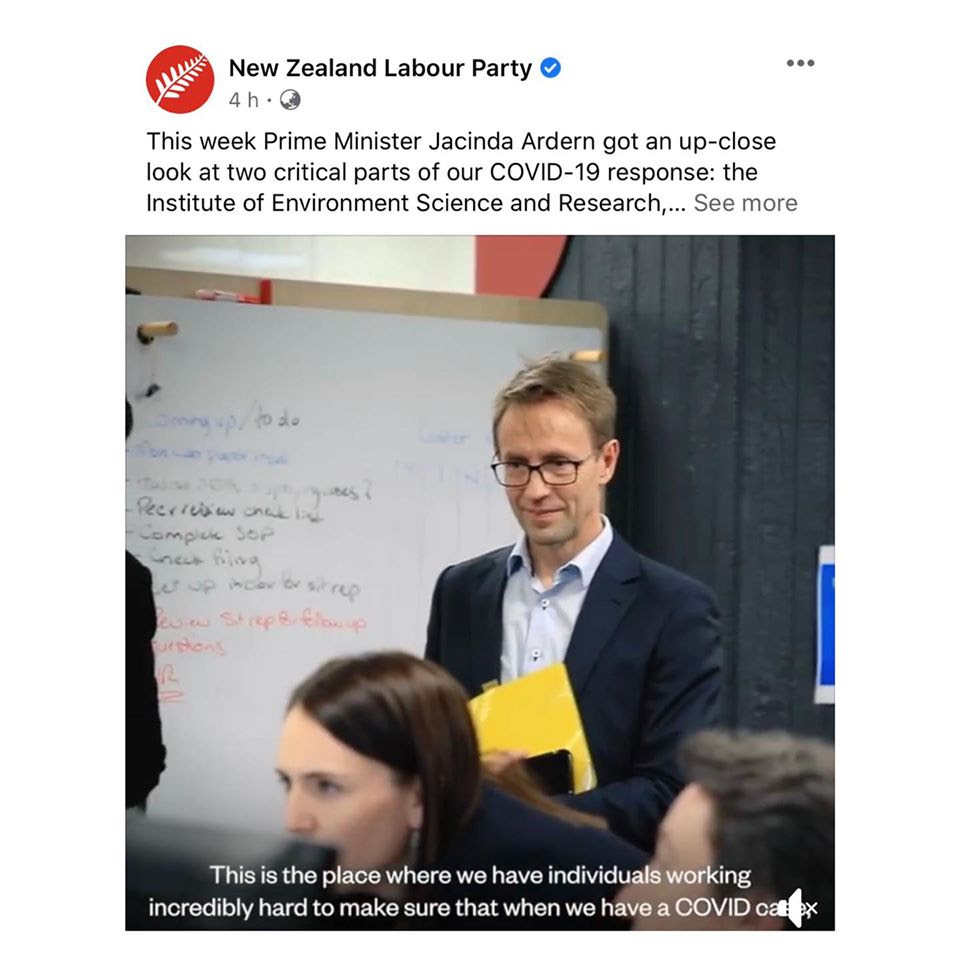
Labour uses Ashley Bloomfield for the election campaign
On Saturday the Labour Party posted a new ad on its Facebook page. The ad was filmed in the Ministry of Health’s contact tracing centre and included a number of public servants, including Dr Ashley Bloomfield (see the still image above).
This is disgraceful. Taxpayer-funded civil servants should not be made complicit in the governing party’s political propaganda. And during an election campaign, it is especially important that the Prime Minister does not use her special access to public servants in a way that advantages her political party. You can read our full comments here.
Shortly after we (and ACT) drew attention to these problems, Labour took down the video for a re-edit. But it’s hard to see how this ad can be salvaged. We’ve lodged a complaint with the State Services Commission.
Local leadership woes show need for recall elections
Two recent stories are sadly typical examples of failed leadership at the local level.
At Tauranga City Council, elected officials are calling for the resignation of Mayor Tenby Powell, who has apparently created a toxic culture, abusing colleagues in front of staff and causing one councillor to claim he hates working at the Council.
The Restaurant Association is campaigning for a taxpayer-funded subsidy on dining out. Usually, a business group wouldn’t dare ask for such a blatant special favour. But in the age of COVID-19, the floodgates have opened with the Government agreeing to handouts for favoured sectors such as the racing industry, and to fashionable businesses like AJ Hackett Bungy.
Financial assistance should apply fairly to all. A temporary cut to GST, for example, would benefit all struggling businesses by encouraging consumers to bring forward spending, whether that be on eating out or on a new washing machine.I made the case for a temporary GST cut in this op-ed on Interest.co.nz.
We’d also suggest that instead of handouts, many businesses could benefit from regulatory relief which doesn’t cost taxpayers a cent. In fact, the Restaurant Association was on to a good thing earlier last week when it suggested restaurants should be able to sell alcohol with their deliveries and takeaways.
$8.8 million beautification of council chamber is obscene
Ratepayers in the Waikato are forking out $8.8 million for the Regional Council’s fit-out of its new office. The Chairman, Russ Rimmington, complained that before renovation the chamber looked like a badminton hall and had ‘no style’. Diddums.
Self-important regional councillors might think they’re entitled to more extravagant surroundings, but most ratepayers will never see the inside of this building. The Council doesn’t even own the building, so the $3.1 million spent on building works won’t be reclaimed at sale down the line. From a ratepayer perspective, this money may as well have been tossed in the river.
More Debt Monster sightings After a brief disappearance during the new COVID-19 outbreak, the Debt Monster is back with a vengeance.New Zealand First staff were alarmed to see him approaching their campaign bus outside Parliament, and drove away moments after this photo was taken: Later, he was seen trying out Trevor Mallard’s $572,000 slide: Witnesses report he’s a big fan.The Debt Monster even tried to give James Shaw a hug at a business breakfast, but the Green Party co-leader wouldn’t face him…
Taxpayer Talk podcast going strong Two more episodes of our Taxpayer Talk podcast are available.In the first, Islay sits down with former Treasury economist Michael Reddell to discuss what the Reserve Bank’s money-printing and interest rate-cutting means for the economy. Listen here.
In the second, I challenge the CEO of Tourism NZ to explain why his agency is spending $10 million on an international tourism campaign while the borders are closed. Listen here. You can find all our Taxpayer Talk episodes on Apple Podcasts, Spotify, Google Podcasts, and iHeartRadio. Have a great week, Louis Houlbrooke Campaigns Manager New Zealand Taxpayers’ Union
“Tauranga Mayor Tenby Powell has apparently created a toxic culture, abusing colleagues in front of staff and causing one councillor to claim he hates working at the Council.” — Kapiti’s mayor with the Waikanae ward councillor obviously aren’t the only example of politicians behaving like this. –Eds
Whenever the government, central or local, decides to withhold information from the public, the question that always gets asked is ‘why — what do they have to hide?’
Everyone knows the main facts about what happened in Christchurch on the Ides of March 2019 — a lunatic visitor from Australia went on a shooting rampage at the two Christchurch mosques in an unexpected and unprovoked racially (not religiously) motivated attack, killing 51 and severely wounding another 49.
The rationale behind it was explained by the gunman Brenton Tarrant himself in a ‘manifesto’ sent by email to numerous outlets — including the Prime Minister’s office — just prior to the rampage. It was swiftly banned by the government; in itself that raised questions. Certainly, exhortations to go out and do the same were unacceptable, but those sentences could have been omitted in an expurgated version. There was no need to ban the whole thing, as the underlying ideology was far from unique to him and, being widespread, requires critical analysis in an open and civilised manner. Driving things underground like the government did only provokes inquisitiveness about what the ‘truth’ is.
The rampage itself was recorded on a helmet camera by the gunman, broadcast live on Facebook and turned into a 17 minute video (it only covered the attack on the Al Noor mosque opposite Hagley Park and not the one at Linwood). That too was swiftly banned. Some overseas media channels such as America’s ABC broadcast some of it (excluding the actual shooting), and Turkey’s President Erdogan made a point of screening the actual shooting at a supporters rally.
Despite the government’s ban, both the manifesto and the video can be found with informed searching on the web (we are not going to tell you how). One useful analysis of it dealt with the question some raised of whether it was fakery (it wasn’t) and whether there was an accomplice (there is some evidence of that). Otherwise it really doesn’t have any redeeming aspects except to demonstrate how incredibly cruel and nasty not just terrorist attacks, but multiple shootings are, particularly of innocent people who have done nothing to deserve it.
The government’s Commission of Inquiry was set up in May 2019, but has yet to report for reasons it has not explained. A month ago came the announcement “The Royal Commission welcomes the Minister of Internal Affairs’ decision to extend the inquiry deadline to 26 November 2020 to enable the completion of its report.” The question most will have is, how much censorship is going to be involved with the public version of the report? It’s a safe bet there will be a lot.
Another intriguing question is why did Tarrant change his plea in April from Not Guilty to Guilty? The likelihood of his being acquitted was zero, but his defense would have been that he was a combatant dealing to invading enemies of NZ. Granted, there was no chance of the Mainstream Media reporting any of that — they made that clear last year — but why did it take a year for Tarrant to change his stance? Did Andrew Little offer him a carrot (better prison conditions) for doing so, or a stick (worse conditions) for not doing so?
Certain media types, such as Patrick Gower and his buddy Professor Spoonley, will for the next week get on their hobby horses with their extravagant obsessive beliefs about their ideological opposites — hard left versus far right (both are problems in this country, but, unlike in America, not a significant threat) — and then hopefully it will slowly fade into history.
As the graphic on the poster above suggests, this in essence is a road movie, but rather different to what the genre usually involves. With occasional exceptions such as The Motorcycle Diaries or Mad Max, the best known road movies have been set in America, usually featuring characters trying to find themselves or avoiding the law, and often in muscle cars, the most iconic of them being Vanishing Point (1971) featuring a 1970 Dodge Challenger and Thelma and Louise (1991) in a 1966 Ford Thunderbird.
Somehow the genre only seems to work well when there are wide open landscapes mostly devoid of people; those set in other environments are less successful.
So — a documentary of an actual fulfillment quest by a golden age English couple (retired lawyer Rupert Grey, the great-grandson of 1830s UK Prime Minister Earl Grey and his wife Jan) driving along the coastal and then mountainous areas of India towards a social-political photography festival, the 2013 Chobi Mela, in Dhaka, Bangladesh — and driving a 1936 Rolls Royce in a rather dubious state of roadworthiness?
The concept is a good one, but the result isn’t so much a cause for enthusiasm, as far too much of the relatively short running time of 80 minutes is allocated to ‘talking heads’ and not nearly enough to photography of what you will get to experience if you were doing the same thing yourself. After all, the colour and chaos of India, and the contrast between grandeur (mostly from British colonial days) and overpopulated squalor are what make the huge country interesting. This is presented, but in short glimpses rather than the lingering exploration that the armchair traveller is keen to see.
The entertainment that one might expect — lunatic driving on rough roads, getting sick from unhygenic food preparation, smoking hashish, cultural rituals, among other things — is more mentioned than shown. The same applies to the presence of insurgents in the mountains: apart from a procession of military trucks, we don’t see any supporting evidence. A key principle of movies is, show us, don’t tell us.
Bureaucracy at the India-Bangladesh border does get lingering treatment and demonstrates one of the things the sub-continent is known for, as well as the less than aimiable relations between the predominately Hindu and predominately Muslim regions of what was pre-1947 India. But there is little of the rest of the trip inside Bangladesh.
The events date back to 2012-2013 and the movie was first released in other countries in 2017, but it doesn’t lose currency except for a reference to Boris Johnson as the Mayor of London when he is now British Prime Minister. However, the presentation leaves you with the feeling of having seen an extended series of highlights rather than a full movie.
Romantic Road is screening at the Shoreline Cinema.
Roger Brent Smith is one of several skilled photographers who like to record the beauty of birds in and around Waikanae reserves. This article is on the NZ Herald website:-
Birdwatch: This time of the year is a great time to watch kingfishers finding food at the Waikanae River estuary, writes photographer Roger Smith.
While kingfisher, also known as kotare, can be spotted anywhere around the Waikanae Estuary Scientific Reserve, the best and most reliable place to see them is at the Waimanu Lagoon outlet near the Tutere St carpark.
Late afternoon when the outgoing tide has exposed the mudflats is a good time to see them, as they hunt for small crabs and small fish in the shallow water.
The interview was recorded last Tuesday and will be broadcast on 104.7 FM on Monday evening, but you can play the Podcast now — the top item in the list on this page of their Website. (Note that for legal reasons the Prvanov case and the Council machinations over it are not discussed).