
by Guy Hatchard

In the 1980s, I bought a Casio handheld programmable calculator and amused myself writing routines that solved algebraic equations, but I soon realised that calculators turn off the thinking process.
The ubiquitous use of calculators in schools has since created generations of mathematically deficient graduates. Predictive text, AI assisted writing, and the decline of reading is now doing the same for language. To some extent we have adapted to these concerning side effects of technology, but what if some technology could prevent us from thinking straight? What would be the consequences? Or more to the point, is it already happening?
In November last year we published an article “mRNA ‘Vaccines’, Cognitive Dissonance and our Future Prospects” in which we reported on rises in cancer incidence and the public warnings being sounded by leading UK oncologists about the role of mRNA ‘vaccines’. There has been some pushback. Apparently, some medical authorities are in denial, they say there is no cancer epidemic taking place. What does the latest data tell us: Yes or No?
The other night I wanted to know how many people were developing cancer in Sweden because there were no lockdowns in the country. It is an interesting question for us because recent media reports of sudden cancer tragedies have been blamed on lockdowns which, according to a widely reported narrative, delayed appointments for check-ups and tests at hospitals. Let’s be clear about it, delays could not actually ‘cause’ cancer, only, as the Lancet reports, complicate treatment and affect outcomes.
Sweden didn’t have lockdowns and they are continuing to publish annual cancer incidence data. Google AI Overview informed me that 69,621 new cases of cancer were diagnosed in Sweden in 2017 and then somehow got stuck and started imagining that there were also 69,261 cases in 2016 and 2015. It wasn’t too much of a problem because I never rely on AI suggestions. I go back to the source data. Table 1 has the official numbers of new cancer cases in Sweden by year published by Socialstyrelsen, Sweden’s National Board of Health and Welfare.
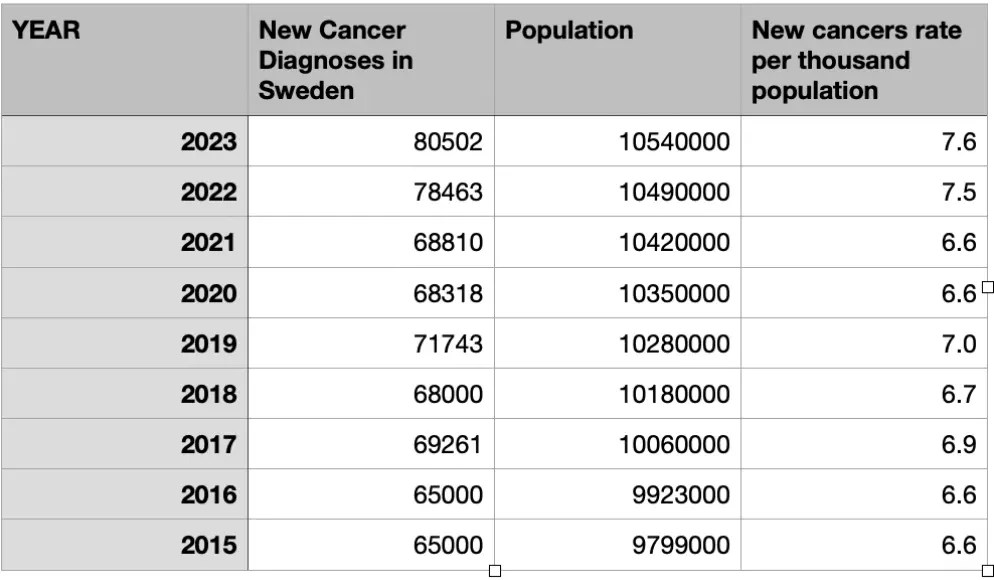
Compared to the average of the pre-pandemic years (2015-2019) when figures remained relatively stable, cancer incidence jumped by 10.9% in 2022 and pushed slightly higher in 2023. In all, it appears there were approximately 20,000 additional cases of cancer over the two years 2022 and 2023 more than you would expect from the historical trend. But it wasn’t due to lockdowns, they didn’t happen in Sweden. So what was the cause? The timing of the rapid increase is indicative and certainly favours Covid ‘vaccines’. 87% of Sweden’s population over the age of 12 received at least one Covid ‘vaccine’ in 2021. It is possible that Covid infection also played a role but far less likely as Covid had its most severe impact in 2020. In any case, the exact relative importance of these two possible factors doesn’t influence an important implication of the figures, both Covid ‘vaccines’ and probably Covid itself came out of biotechnology labs and exposed our internal cellular biology and immunity processes to novel bio-engineered genetic structures.
If Covid ‘vaccines’ are at fault, as some senior UK Oncologists like Dr Angus Dalgleish and Dr James Royle think, (who btw are not conspiracy theorists, a term that is often used to shut down legitimate discussion about valid concerns) the timing also indicates that the speed of post mRNA ‘vaccine’ cancer development qualifies for the epithet ‘turbo’.
I wonder whether Professor Pat Price, oncologist and chair of Radiotherapy UK, or Helen Petousis-Harris, associate professor in the Department of General Practice and Primary Health Care at the University of Auckland, have given any serious thought to the cause of rapidly rising cancer incidence? Causality is not rocket science. The gold standard involves identifying the timing of new elements or sudden changes in diet, behaviour, environmental exposure or medical interventions.
The Swedish data clears up one point, it wasn’t lockdowns. In fact that explanation was never plausible. Delays in testing do not cause cancer, they merely delay treatments which might affect mortality, but not incidence. The figures for 2022 indicate a sudden very large unprecedented rise in cancer incidence. As a result, the list of usual cancer suspects doesn’t apply. In 2021 over a short period of time whole populations did not suddenly begin to eat vastly more junk foods, avoid exercise altogether, ban breastfeeding, or purposely add pesticides to their meals, but almost everyone did get Covid mRNA ‘vaccinated’ in a hurry.