
by Larry Johnson on Sonar21.com
There’s a certain kind of man who stands next to a powder keg tossing lit matches and then acts shocked when somebody yells at him. Europe has become that man.
In the space of a single week, Ukraine knocked down part of the Kerch Bridge with a lot of help from NATO’s eyes in the sky. Then, on Saturday, drones set a Russian military cargo ship ablaze in the Gulf of Finland, and by Saturday night air raid sirens were wailing over Kaliningrad and explosions were being reported near the headquarters of Russia’s Baltic Fleet. Every one of these strikes required something Ukraine can’t produce on its own: geography, airspace, or intelligence belonging to a NATO country.
The Europeans call it supporting Ukraine’s right to self-defense. Moscow is going to call it something else. And at some point, Moscow is going to act on its definition, not Brussels’.
A ship in the Gulf, sirens in Kaliningrad
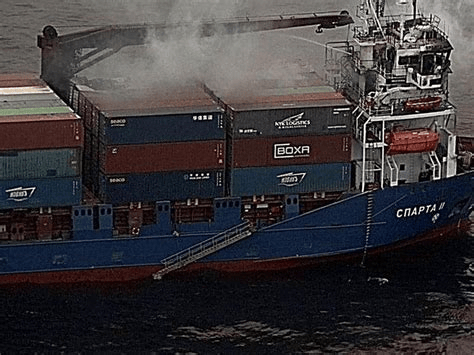
Start with the ship. On Saturday morning, the Sparta II, a 121-meter Russian-flagged cargo vessel, was hit by two drones in the eastern Gulf of Finland, west of Russia’s Gogland Island. Its owner is Oboronlogistika, the Russian Defense Ministry’s shipping arm, and the vessel is under US sanctions. It was headed from the St. Petersburg area to Kaliningrad. The bridge caught fire, the 16-man crew took to the lifeboats, and the burning hulk drifted into Finnish waters.
Finland’s armed forces said it was “likely” that Ukraine was behind the attack. Finnish Prime Minister Petteri Orpo said the war was spilling over into Finland’s neighborhood and, in the same breath, that Ukraine “has the right to fight against the aggressor.” Translation: we’d prefer you didn’t do this on our doorstep, but we’re not going to say no.
Then came the night. Sirens went off across Kaliningrad Oblast, and residents of Baltiysk, home port of the Baltic Fleet, reported explosions and drones while Russian air defenses opened up. Airport operations were restricted. If the reports hold, this was the first drone attack on Kaliningrad itself in the entire war. The Russian side has not confirmed a hit on the base, and the details remain murky. But one detail stands out: the regional authorities initially reported a suspicious object approaching from the direction of Lithuania.
Think about the map. Ukraine doesn’t border the Gulf of Finland, and it doesn’t border Kaliningrad. To get a drone to either one, you have three choices: fly it the long way across Russia and hope Russian air defenses miss it, launch it from a boat somebody lets you put in the Baltic, or fly it over a NATO country. Ukraine has done the first many times this year against the oil ports at Ust-Luga and Primorsk. The other two require a NATO country to look the other way. And a drone coming at Kaliningrad from the direction of Lithuania didn’t take the long way around Russia.
Estonia’s open skies
Which brings us to Estonia. On Saturday, the Estonian Defence Forces raised a drone alert for Lääne-Viru and Ida-Viru counties, the stretch of northern Estonia that faces the Gulf of Finland. NATO’s Baltic air policing F-16s were scrambled. And then, as far as anyone has reported, nothing happened. No drones shot down. No public complaint from Tallinn about foreign military drones transiting its airspace. Estonia’s Police and Border Guard put out a statement about explosions aboard the Sparta II and said it was “monitoring the situation.”
Monitoring. That’s a word you use when you watch something happen that you have the means to stop and decide not to. Estonia has shown it can shoot down a Ukrainian drone when it wants to; a NATO jet did exactly that over Estonian territory earlier this year, in the first case of its kind. European sources say the drones that hit the Sparta II came from Ukraine. At a minimum, they flew over or past Estonia to get there. If Tallinn didn’t stop them, it either couldn’t or wouldn’t. I’d like someone in the Estonian government to tell us which, because neither answer is reassuring.
Moscow, for the record, warned about precisely this back in March. Kremlin spokesman Dmitry Peskov said Russia would respond if other countries provided their airspace for hostile activity against Russia. Nobody in the Baltics seems to have taken that seriously. They should have.
Continue reading: https://sonar21.com/striking-matches-near-the-powder-keg