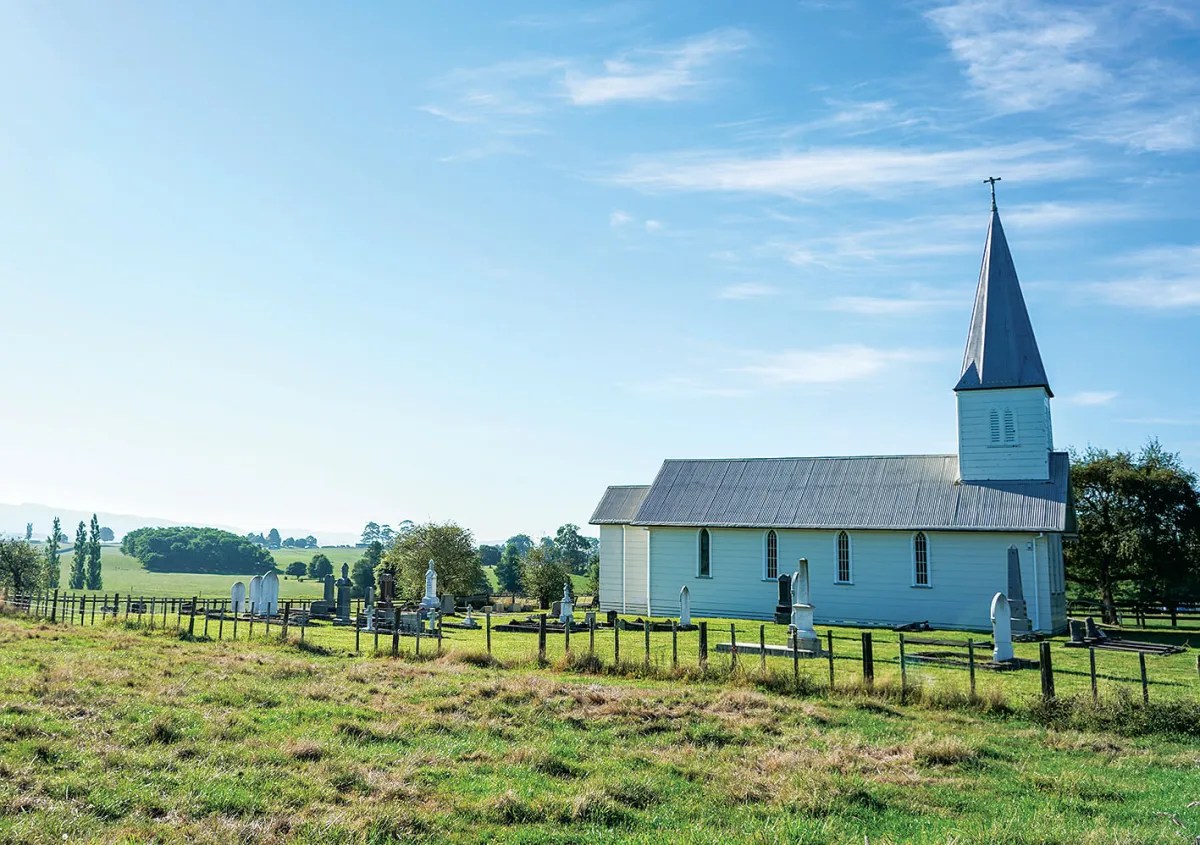
St Paul’s Anglican Church, Rangiaowhia. Photo from Cambridge News
The Far Left Newsroom state-subsidized website has published a neo-Marxist version by Vincent O’Malley of this event in NZ history.
In the interests of truth, below is the chapter on Rangiaowhia from Roger Child’s book on the school history curriculum created by the Jacinda regime. Bruce Moon edited it.
Chapter 5
LIES AND TRUTHS ABOUT RANGIAOWHIA
On 21 February 1864, 1,000 British troops marched into the tiny, defenceless village of Rangiaowhia and wantonly slaughtered a hundred women and children. Or did they?
Dispelling appalling lies
There is no way that General Cameron, the chivalrous Commander of the Government forces confronting the rebellion in the Waikato, would contemplate the killing of defenceless women, men and children. He had criticised Kingite leader, Wiremu Tamihana, for having women in the front lines at the earlier Battle of Rangiriri. What would he have to gain by ruthlessly disposing of Maori civilians? Certainly his reputation for being humane and wanting to avoid unnecessary casualties would be shattered for all time. 2
The Rangiaowhia skirmish and the 2014 Otorohanga College field trip that led to the petition to remember the so-called “New Zealand Wars”, highlights significant problems with the new history curriculum. Notably there are the serious flaws related to:
- getting just one side of the story
- the dangers of relying on tribal versions of an event, unsupported by evidence
- the limitations of oral history
- failing to get hard evidence to support historical conclusions
- historians pushing their own version of history without primary evidence.
The Otorohanga College student petitioners had visited Rangiaowhia and one commented that “the grief was still real”. This was grief 156 years after the event!
Occupying Rangiaowhia was a sensible strategy
Cameron did want to occupy Rangiaowhia in early1864, because it was the major source of food for the Kingite forces, who manned the powerful set of forts at Paterangi. To get to the village he had skillfully by-passed these fortifications in the dead of night, to avoid alerting the rebels.
Cameron’s strategy made perfect sense as he wanted to avoid unnecessary deaths on both sides and shorten the Waikato rebellion. The warriors at Paterangi were furious when they learnt that they had been outwitted.
There was a small engagement at Rangiaowhia which was started by local armed Maori preparing to take food supplies to Paterangi. One whare in particular wasn’t going to give up without a fight, despite being asked to surrender several times. It was a sturdy building with only one low, narrow entrance, making it difficult to capture. A rifle pit had been dug inside which made it easy to defend. There were a small number of casualties on both sides and in the end, the whare which would not surrender was set alight, to end the impasse.
Participants and eye-witnesses at the time, the only ones an historian should consult, did not regard the whare “battle” as untoward, and after this minor action in Rangiaowhia the Waikato rebellion moved on towards its inevitable conclusion.
Analysing what was alleged to have happened through the eye-witnesses
There are no credible eye-witness accounts of women and children being burnt to death in a church in Rangiaowhia on 21 February1864. Who exactly were the Maori from the village and nearby Te Awamutu who allegedly were aware of:
- the smoke from the burning church billowing in the air?
- the dreadful screams of the women, men and children trapped inside?
- the collapse of the church roof?
- sifting through the rubble to find the human remains?
- the burial of the remains in a mass grave?
There WERE none, simply because it never happened!
Eye witness accounts on both sides
There are just three Maori documents that relate to eye witnessing what happened in Rangiaowhia. There were definitely no Maori spectators watching what was going on! Some warriors and women were snipers in the Catholic and Anglican Churches but soon gave up and ran away into an adjacent swamp. Most women and children had fled, or obeyed the soldiers and got out of the village, or hunkered down in their homes.
Te Hauata Rahapa Paoa, the wife of settler Thomas Power, was at home with her children when the soldiers arrived. She put a white flag on the roof of her house. Having been warned by Captain Wilson leading the vanguard, many women and children fled to the shelter of her home, and the troops gave her place a wide berth. 14 months after the action she wrote to Governor Grey and mentioned that: “We were living comfortably at our home, when … the soldiers arrived …” There was no reference to women and children being burnt to death in the letter.
Another contemporary account comes from Wiremu Tamihana a leader of the Ngati Haua. A week after the action in Rangiaowhia he wrote a letter to two East Coast chiefs. Most of it related to the short battle of Harini on 22 February, but there was brief reference to what happened in Rangiaowhia. “… an attack was made on Rangiohia (his spelling), a stealthy assault by the Pakehas. They fell (the Maoris) and six were killed in one place …. These men were attacked at night, the payment was eight, all officers. Enough of that.” Nothing about women and children being slaughtered.
The key Maori eye-witness account however was from one Potatau who, as a young lad saw part of the action. “I at once ran to my father’s house. I had not been long there when my grandfather [Hoani] came to the same house … so that he might die with us – Ihaia, Rawiri and his son.
At this time myself and my mother went outside the house, and sat at the door of the house. I heard my father say to my grandfather: ‘Let us lay down our guns and give ourselves up as prisoners.’… My grandfather would not agree. At this time the soldiers came to us, and asked my mother in Maori: ‘Are there any Maoris in the house?’ She replied: ‘No, there are no Maoris in the house.’ My father at once said: ‘Yes, there are Maoris here.’
The European [Captain Wilson], who spoke Maori came to the door of the house, and caught hold of my father, and handed him over to the soldiers.”
(Shortly after this, Potatau and his mother were allowed to leave the whare where most of fighting occurred later, and they went to the Powers’ house.)
There are at least ten eye-witness accounts from soldiers including the legendary Forest Rangers leader Gustavus von Tempsky, and from the press, who were always looking for a good story and were not afraid to criticise the government and the military leaders. Although these accounts differ in some details, there is no reference to women and children being burnt to death.
Despite the best efforts of honest historians like James Cowan, John Robinson, and Bruce Moon, and in Hoani’s Last Stand The Real Story of Rangiaowhia by Piers Seed, published in 2022, the truth about Rangiaowhia has struggled to gain recognition.
So how did the “story” of women and children being slaughtered in the village get started?
If you haven’t got enough information – make it up?
Over the last 20 years there have been a number of stories propagated about the so-called “atrocities” committed in the village. Historians such as Jock Phillips and Vincent O’Malley, who should know better, have jumped on the band-wagon and accepted the atrocity story.
The worst version, 3 is that over 100 women and children were herded into a church which was set on fire. (Unfortunately for the myth-makers the two Rangiaowhia churches were still standing after the action on the day!)
Moreover, the tall tales of atrocities have been parroted by historians, public figures like one-time Race Relations Commissioners, Susan Devoy,4 tribal leaders, journalists and college students who have failed to do their own research and check the facts.
It is appallingly evident that in the new school history curriculum, the blatant lies of the rebel losers about what happened on 21 February, 1864, in Rangiaowhia will be passed off as genuine history to our unsuspecting youngsters. (Rangiaowhia was the only incident in the Waikato Rebellion (“New Zealand Wars”) mentioned in the draft curriculum.)
As one participant who reported later explained “At the great Maori meeting at Kopua, twelve months last May, Captain Wilson met two gentlemen – Wesleyan ministers – who informed him that there was but one thing the natives were sore about; namely, the kohuru [murder] at Rangiaowhia.
This fabrication was taken up by Kingite advisor and general, Wiremu Tamihana. A year and a half after the occupation of the village in August 1865, Tamihana presented a petition to Parliament and mentioned “… the women and children fell there.” But his earlier letter (referred to above) had made no such allegation! In 1866 in another petition fire comes into it “… because my women and children having being burnt alive.”
Come through to the 21st century and a Bay of Plenty Times journalist, one Tommy Wilson, gave the myth its full extension – “… troops herded all the local Maori up like cattle and locked them in the church then set it alight – killing all 144 inside.”
There is a tangible reminder at the site of Rangiaowhia of the enduring lies. On a memorial stone are these words:
This stone is a memorial to the atrocities suffered by Ngati Apakura, Ngati Hinetu and others here at Rangiaowhia on the 21st of February 1864.
At the site of its old mission, the Catholic Church has erected a sign which says in part, “on Sunday 21st February 1864, the Imperial forces attacked the undefended settlement which was inhabited by women, children and the elderly”. Thus does a church which claims to uphold “eternal truths”+ mislead those who would visit the site.
Vincent O’Malley’s convictions about “atrocities”
O’Malley is regarded by the mainstream media as one of New Zealand’s top historians and a leading authority on the country’s 19th century history. But the reality is, he is very selective in the evidence he provides and subjective in his conclusions. At a talk in Wellington a few years ago he admitted his intense dislike of the English because of what they allegedly did to his O’Malley ancestors in Ireland two centuries ago!
On the Rangiaowhia incident O’Malley commented: “For Kingitanga supporters … the assault on Rangiaowhia was an almost incomprehensible act of treachery.” He also stated: (They moved their families out) “… only for the troops to deliberately target them in the most horrific manner possible.” “… those killed in the attack were not victims of war: they were non-combatants who had been brutally murdered.” Furthermore O’Malley claims: “It is clear from the multiple eyewitness accounts that Maori were deliberately burnt to death at Rangiaowhia.” 5
None of the foregoing allegations are true!
So what are these eye witness accounts? O’Malley has found just one in a letter from Mac Burt to the Waikato Times in 1991 where there are the recollections of an unnamed Maori woman who told the story to a descendant about 1936. But not knowing the exact source he does concede that it needs to be treated with caution. But he then goes on to say “… It is but one strand of a powerful oral tradition of the Tainui, surviving to this day, about these events.” No other strands are mentioned.
Hoani’s Last Stand The Real Story of Rangiaowhia, by Piers Seed is the most recent attempt to put the record straight on what really happened in the village on 21 February, 1864. But will the right people read Seed’s book? Will today’s revisionist historians have the integrity to admit they have got it wrong and that there is no evidence to support the false tales that there were atrocities committed in the village?
In the final section of his book Seed narrates verbatim all the known eye-witness accounts of the skirmish in Rangiaowhia and none of them mentions a church burning down or the massacre of women and children.
Teaching and learning the truth
Nelson historian Bruce Moon neatly sums up what should be in the history books, and the new curriculum, for our impressionable children to learn the truth.
“It was General Cameron himself who led the expedition to Rangiaowhia, to cut off the food supplies to the strong rebel fort at Paterangi and thus to avoid a frontal attack on that fort with heavy losses of life on both sides. Nearly all the women and children escaped when permitted to do so and it was only armed resistance by a few rebels which led to loss of life on both sides.”
The Otorohanga senior students who were the catalyst for the development of the new curriculum, had been to Rangiaowhia, and were taken in by the atrocities story. No doubt in the remembrance section of the Years 9-10 programme, many teachers will be trotting out the lies about General Cameron burning women, men and children. In one of the School Journal articles Years 7-8 pupils will read, there is a reference to “The brutal attack of Rangiaowhia by the British …” 6 It seems highly likely that the lies and myths will be perpetuated.
References
1 Hoani’s Last Stand; The Real Story of Rangiaowhia, Piers Seed, P. 6
2 Cameron, with commendable humanitarianism, wanted to avoid a set piece … confrontation, F.Glen, Australians at war in New Zealand, ISBN 978-1-87742-739-8, 2011, P.146 (We may ponder whether such considerations were foreign to the Maori warrior ethos in which stratagems were a normal element.)
3 Once again, in the “Bay of Plenty Times”, on 4th January 2017
4 Ibid
5 Voices from the New Zealand Wars, Vincent O’Malley
6 Harakaia: Warrior and Peacemaker, School Journal Level 4, May 2015, Mark Derby
And the murderous Te Raparaha gets an arena named for him in Porirua! It seems only the “white man” is demonised by these so called historians.
Yes, the neo-Marxist-Racists’ ideology.
Bruce Moon concedes that not all the women and children escaped when permitted to do so and it was only armed resistance by a few rebels (I assume women and children were also rebels) which led to loss of life on both sides.
Piers Seed in his book acknowledges that a number of houses were set alight, but suggests this was not intended to kill Māori, only to drive them out. Piers may suggest the soldiers intentions were not to kill, but provides no evidence of that.
If you set a building alight it should not be a surprise if it’s inhabitants might be burned. What is known is Māori were burnt to death, Piers does not dispute that.
One has to remember why there were land wars in the first place, and why they were initially titled Māori Wars. No colonizer ever went to any shores just to benefit ‘the natives’. One also has to think about why the colonial government confiscated 6 million acres. It’s the victors who write the histories.
True, but that’s no excuse for giving historical incidents ‘Hollywood script’ treatment and then promoting them as factual.